Get Full Government Meeting Transcripts, Videos, & Alerts Forever!
Get email alerts on the Water Meter Audit topic
No spam. Unsubscribe anytime.
Independent audit: Gilbert water meters, billing largely accurate; 2.9% of accounts showed anomalies
Summary
An independent Kimley‑Horn audit found about 97.1% of Gilbert water accounts recorded usage and were billed accurately from 2020–2025, while roughly 2.9% of accounts (about 2,700) experienced at least one anomaly; auditors recommended targeted fixes, multiplier checks and continued meter replacement.
Kimley‑Horn presented preliminary results of a comprehensive water meter audit to the Gilbert Town Council on April 7, saying the testing and data review found the system to be fundamentally sound but identified targeted anomalies affecting a small share of accounts.
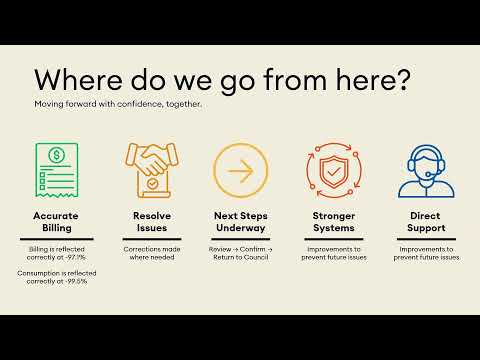
"We can validate that statement that there are no system‑wide issues," the audit team said, reporting that about 97.1% of all accounts were recording usage and billed accurately during the audit period (Jan. 1, 2020–Dec. 31, 2025). The firm said roughly 2.9% of active accounts — about 2,700 of roughly 93,000 accounts — experienced at least one issue during the six‑year period.
The firm analyzed more than 7 million consumption transactions and concluded 99.5% of those transactions were calculated correctly; 0.5% were incorrect due to causes such as canceled bills, dead batteries, incorrect multipliers or historical billing codes. "We concluded 99.5% of those transactions were calculated correctly," the auditors said.
Kimley‑Horn described the audit method: physically testing a statistically representative sample (451 meters were removed and sent to a calibrated facility for testing and 394 radio transmitters were field‑tested), analyzing nearly 50 million data points, and applying AWWA standards to achieve at least a 95% confidence level in the samples.
The audit flagged multiplier configuration errors as a key source of billing variance. For residential accounts auditors identified 506 multiplier issues (201 with a higher multiplier, 296 with a lower multiplier, and nine accounts that experienced both) and calculated average total impacts on affected residential accounts: about $58 total overbilling where outstanding and about $1,200 total underbilling in some undercharged residual cases. Auditors said many multiplier problems have already been corrected.
The physical meter tests showed the newer Mueller meters largely tested within tolerance (50 of 51), while older Sensus meters were more mixed. Meters that failed were typically about 2% outside manufacturing tolerances, and the average financial impact per affected residential customer from a meter outside tolerance was estimated at about $34 over its life.
Auditors recommended continuing prioritized meter replacement, implementing automated recurring multiplier health checks, adding system flags for billing‑code mismatches and unusual usage, and improving customer communications on rate calculations. They said the final report — which will include full supporting data and the remaining calibrated test results — will be posted at khwatermeteraudit.com at the end of the month.
Town staff reiterated the audit’s independence and said there were no systemic issues, and they outlined next steps including individual account review, possible credits or refunds where overbilling is confirmed, standard‑operating‑procedure updates, improved asset and vendor data management, and a return to Council after staff review of the final report.
During council Q&A, staff explained rounding policy ("cascading rounding" to the nearest 1,000 gallons, with 445 and above rounding up) and said the town aims for a 20‑year meter replacement cycle but prioritizes replacement by high usage and age. The audit team and staff encouraged customers who still suspect an issue to request an efficiency check with the town.