Get Full Government Meeting Transcripts, Videos, & Alerts Forever!
Get email alerts on the Human Services Finance topic
No spam. Unsubscribe anytime.
Senate committee advances human services finance bill after hours of emotional testimony on disability waivers and provider funding
Summary
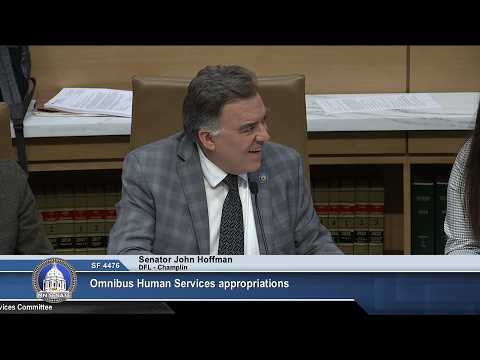
The Minnesota Senate Human Services Committee held a lengthy markup of Senate File 4476, hearing emotional testimony from family residential providers, disability advocates and counties about proposed repeal or delay of the 'Reimagine' waiver, cuts to family residential payments, and program-integrity measures; the committee adopted multiple amendments and recommended the bill to pass as amended to Finance.
The Minnesota Senate Human Services Committee advanced the Human Services Finance bill (Senate File 4476) after a day of public testimony and debate over changes to disability waivers, family residential payment rates and safeguards to prevent fraud.
The session opened with the chair announcing a planned markup and asking the public to limit testimony to two minutes because senators planned to consider dozens of member amendments. Dozens of providers, family members and advocates filled the committee room and the Zoom queue to press the panel on competing priorities: preserving continuity of care for people with disabilities, stabilizing small family residential providers, and strengthening program-integrity tools to curb suspected fraud.
Why it matters: Senators were weighing savings and policy changes intended to reshape long-term supports and behavioral health funding against stark warnings that some proposals would force people out of home-based settings and into larger, more restrictive facilities or cause small providers to close. Multiple speakers described concrete harms they said would follow if the changes went forward without robust transition plans.
Advocates and providers pressed for repeal or a pause to the state’s “Reimagine” waiver transition. Jillian Nelson of the Autism Society of Minnesota told the committee she supported repeal or a staged delay of the waiver and asked that sensory-processing needs be explicitly preserved in nursing-level criteria. "Removing language recognizing sensory-processing needs risks access to necessary supports," she said. Several family members and one registered nurse who assesses clients urged full repeal, saying the waiver as written could undermine the Olmstead principle of community integration.
Family residential providers described the fiscal stress of a tiered, flat-rate payment model. Providers including Brian Beard and Carly Mannion said proposed cuts would make small, licensed family homes unsustainable and risk displacing residents. "This will force our homes to close," a provider said, adding that the flat-tier payment does not cover household expenses, training, liability and 24/7 staffing.
Testimony also highlighted individual cost comparisons. A parent and nurse, Kathy, told senators that keeping her son Kylen at home saved taxpayers "over $500,000 a year" compared with institutional placement, and argued that local, individualized care both complied with federal integration law and reduced costs.
DHS, counties and program-integrity advocates navigated competing legal and operational duties. County representatives and DHS staff raised concerns about a canceled RFP to centralize non-emergency medical transportation and sought statutory fixes to avoid a legal gap that could leave counties without contracting authority. DHS said it had paused EMT implementation and would work with the committee on language to postpone rollout and preserve ancillary services.
A heated procedural exchange centered on whether the bill should constrain the commissioner’s ability to withhold payments when federal regulators or investigators raise fraud concerns. Office of Inspector General staff said federal law can require withholding payments when credible allegations of fraud exist; other senators argued that withholding must be paired with a continuity-of-care plan so clients do not lose services while investigations proceed. DHS and OIG agreed to continue technical discussions to align state practice with federal requirements while protecting service continuity.
Amendments and committee action: Senators offered and the committee adopted a long list of member amendments (many adopted by voice). The chair moved that Senate File 4476, as amended, be recommended to pass and be referred to the Finance Committee; the motion carried on a voice vote. The committee directed staff to make technical and conforming changes reflecting the committee’s intent.
What’s next: The bill was recommended to the Finance Committee; further changes and federal approvals (for payment methodology changes) are likely in coming weeks. Senators and stakeholders said they would continue negotiations on waiver timing, rate adjustments and program-integrity language to minimize service disruptions while addressing alleged fraud and long-term fiscal pressures.
The committee’s action does not by itself change law; any final adjustments to waivers, payment methodology or administrative authority will require further committee votes and, where relevant, federal approval for Medicaid plan amendments.