Get Full Government Meeting Transcripts, Videos, & Alerts Forever!
Get email alerts on the Body Worn Cameras topic
No spam. Unsubscribe anytime.
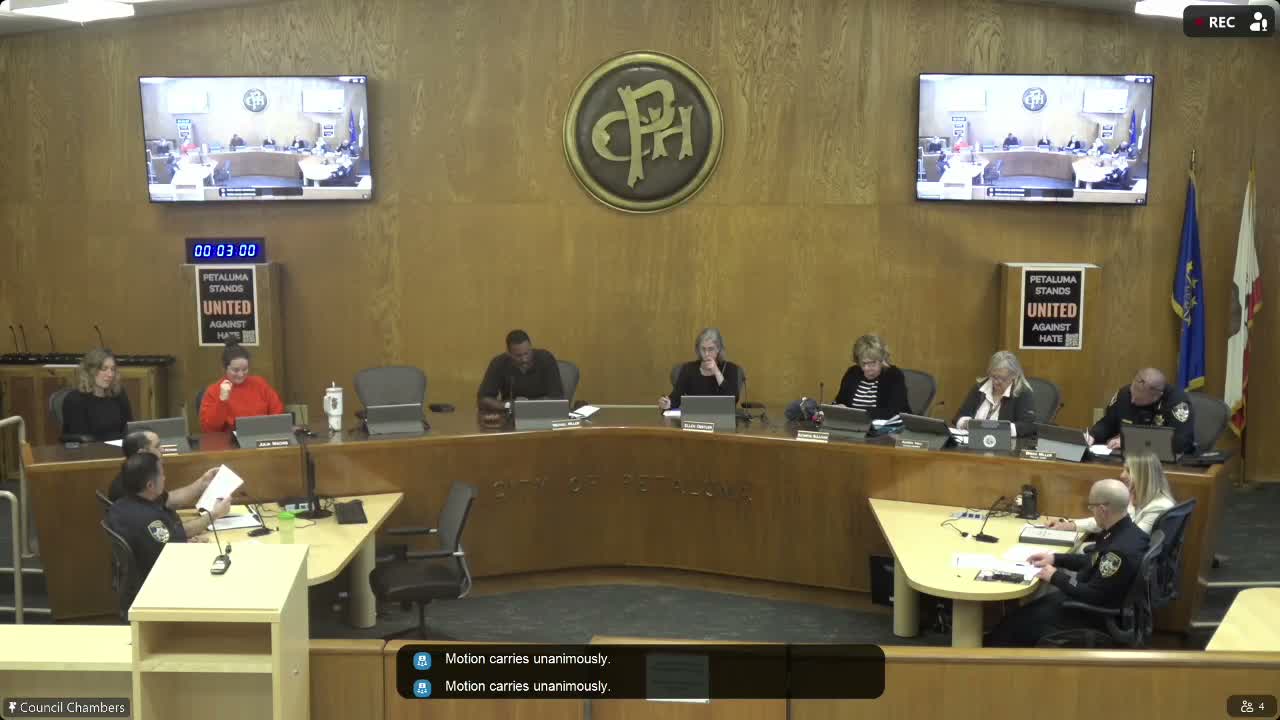
Petaluma advisory committee hears police overview of body-worn cameras as residents press for ALPR transparency
Summary
The Public Safety Advisory Committee received an overview of the Petaluma Police Department99s body-worn camera program, including activation rules, a 30-second pre-event buffer, storage on evidence.com and legal limits under SB1421 and AB748. Residents urged more public reporting on Flock ALPR use; the independent police auditor reported nine new uses-of-force in February and 15 pending reviews.
The Petaluma Public Safety Advisory Committee on March 25 heard a department presentation on its body-worn camera program and fielded sustained public concern about automated-license-plate-reader (ALPR) "Flock" use and broader transparency.
Department presenters described the Axon system in use, saying cameras are manually activated, record a 30-second buffer of pre-event video without audio, and are kept on for the duration of an incident "whenever practical." The department said officers must activate cameras during calls for service, traffic stops, investigative contacts and adversarial custody transports. Access to recordings is restricted, tracked and audited, and the city99s contract model with evidence.com includes cloud storage, the presenters said.
"We have strict safeguards in place," a police department representative said, describing retention and auditing practices and noting that footage cannot be deleted by officers and is reviewed in investigations. Presenters cited state rules requiring at least two-year retention for certain recordings, and mentioned SB1421 and AB748 as expanding public access to serious-incident footage and mandating specific timelines for release in critical cases.
Residents used the presentation item to press for stronger public reporting and City Council action on ALPR technology. Chantal Rogers, a Petaluma resident, said she was concerned that a prior committee recommendation on the city's Flock camera use had not been taken up by the council and urged the committee to push for an agenda item before the grant-paid pilot ends in September. "If you would like to see them discuss the issue, you will need to do more than vote that it should happen," Rogers said.
Another commenter urged clearer, field-level transparency from oversight contractors and suggested published metrics that would show how often Flock data are accessed and for what purposes. The department said it posts a Flock transparency page and is discussing whether to publish audits on its portal, and that it has disabled sharing with agencies found to have violations in audits.
Committee members focused a number of technical questions on how the cameras notify the public and on buffer length. Presenters said the audible beep or vibration function is intended as an officer reminder and may be turned off for safety; they said the buffer is industry-standard 30 seconds and there is no automatic post-incident buffer. Extending the buffer is technically possible but reduces battery life during long shifts, the department said, and hardware and contract upgrades over time may improve battery performance.
The session also included a regular update from the independent police auditor. Denise Lewis of Intersure reported 15 pending cases under review and nine new uses-of-force in February; she said seven investigations were conducted or pushed to the auditor and eight were reviewed during the month. "We go far and few between in seeing violations of body-worn camera policy; usually those are inadvertent," Lewis said, adding that many compliance issues are handled by the department through supervisor counseling or training before they rise to auditor action.
Committee members requested more granular breakdowns of the uses-of-force figure, including whether incidents involved Petaluma residents and how many were "shows of force" versus active uses. Auditors and staff said those fields exist in the RIPA dataset and promised to include more comparative detail in an upcoming annual report.
What happens next: staff said they are discussing additional transparency steps for ALPR audits and will work with the city manager and council on whether to publish audit results or usage metrics. The committee also scheduled future agenda planning and agreed to consider drone and unsheltered response topics in coming months.