Get Full Government Meeting Transcripts, Videos, & Alerts Forever!
Get email alerts on the Urban Tree Planting topic
No spam. Unsubscribe anytime.
Relief Petaluma proposes spring plantings across Petaluma, seeks written landowner approval for Lynch Creek sites
Summary
Relief Petaluma outlined plans for roughly 70–80 street and trail trees this spring — including 15 at Lynch Creek Trail and about 15 on Magnolia Drive — and said Public Works has tentatively approved many sites but written landowner permission and final irrigation plans remain pending.
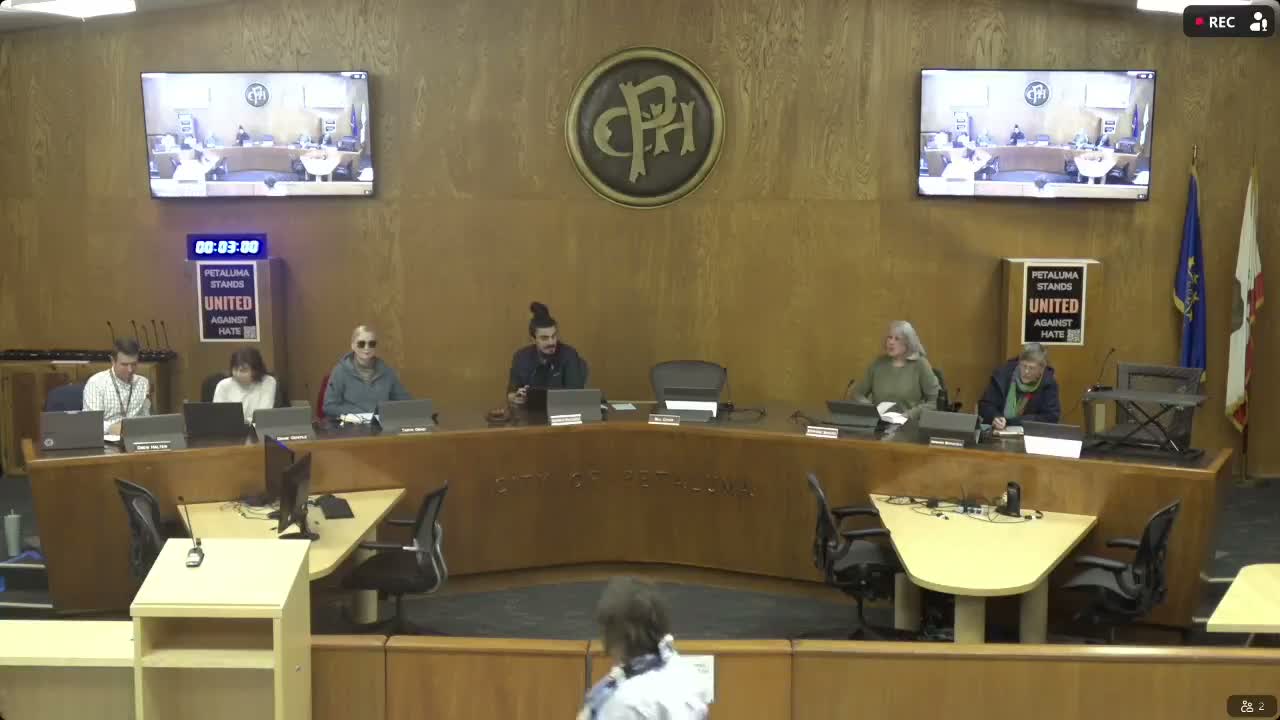
Relief Petaluma presented a multi-site planting plan at the Tree Advisory Committee meeting on Feb. 18, proposing new trees on Lynch Creek Trail, Magnolia Drive and several stretches of Sonoma Mountain Parkway and other public rights of way.
The organization said it plans about 15 trees along the Lynch Creek Trail approach to the arch and roughly 13–15 trees along a treeless stretch of Magnolia Drive near three adjacent cemeteries. Relief staff also described about 35 candidate replacement sites identified from roughly 60 suggestions and multiple sections of Sonoma Mountain Parkway where work would extend a prior 29-tree project.
"We're trying to get some more trees in the ground before the rain stops," Relief representative Wendy Jacobs said during her presentation, listing oaks, some evergreens (including Santa Cruz ironwood), maples, buckeye and cherry varieties as likely species.
Why it matters: committee members and staff emphasized that these plantings are part of a broader urban-forestry strategy tied to the city’s Urban Forest Management Plan and the pending Tree Preservation Ordinance (TPO). Many of the proposed sites have been preapproved by Public Works, but several implementation details remain unsettled.
Relief told the committee that Public Works agreed to irrigate and maintain some medians (using reclaimed water where connected) and that Public Works will maintain the Lynch Creek approach trees for three years before turning responsibility over to the city. Jacobs said Relief provides volunteer maintenance and temporary watering ("water buffalo" tanks) until permanent drip irrigation is installed.
A potential complication: the strip for a portion of the Lynch Creek planting is in a land-swap transaction between the city and a private owner, the business Wizard of Metals. "We had a good meeting with Nathan Apple," Jacobs said. "We almost have his approval," but she added Relief did not yet have the permission in writing and said planting could be delayed if documentation isn’t finalized before the end of the planting season.
Committee members raised questions about past tree mortality in some sites and whether irrigation had been turned off by property managers. "I remember...there is irrigation, but they just simply turned it off," committee member Taryn said about a stretch where redwoods previously died. Jacobs replied that species choice and irrigation are central to improving survival and that Relief sometimes replaces difficult trees more than once.
Funding and partners: Jacobs named the U.S. Forest Service and other local partners as primary funders and said Public Works had preapproved many stretches. Relief also reported success with a prior Sonoma Mountain Parkway project where 29 trees were planted and all but one survived.
Next steps: committee members encouraged Relief and staff to continue outreach (courtesy door-knocks and flyers along Magnolia), to confirm written landowner permission for Lynch Creek, and to firm up irrigation budgets and drip installation timelines. Relief also offered a rare "oracle oak" specimen for a ceremonial planting; committee members discussed integrating a ceremonial planting into a March event that would help publicize the Urban Forest Management Plan and the Tree Preservation Ordinance as they move to the planning commission and city council.
Relief’s presentation included maps, species suggestions and a list of dates the group already has scheduled for plantings in March (March 7, March 14 and March 29). The committee closed the item after praise for Relief’s volunteer work and a short question-and-answer period.
Ending: The committee asked staff and Relief to return with written confirmations on property permissions, irrigation plans and a proposed planting schedule to ensure the spring plantings proceed before the rainy season ends.