Get Full Government Meeting Transcripts, Videos, & Alerts Forever!
Get email alerts on the Service Modifications topic
No spam. Unsubscribe anytime.
Petaluma transit managers propose Sunday and late‑night cuts, possible end to LumiGo to help close multi‑year shortfall
Summary
Petaluma Transit staff recommended eliminating Sunday service, ending weekday evening service by 7 p.m., and pausing the LumiGo microtransit program as part of a package of cuts and revenue moves that staff say would substantially reduce a projected three‑year budget gap. Committee members asked for tighter numbers and favored the more aggressive three‑year plan for council consideration.
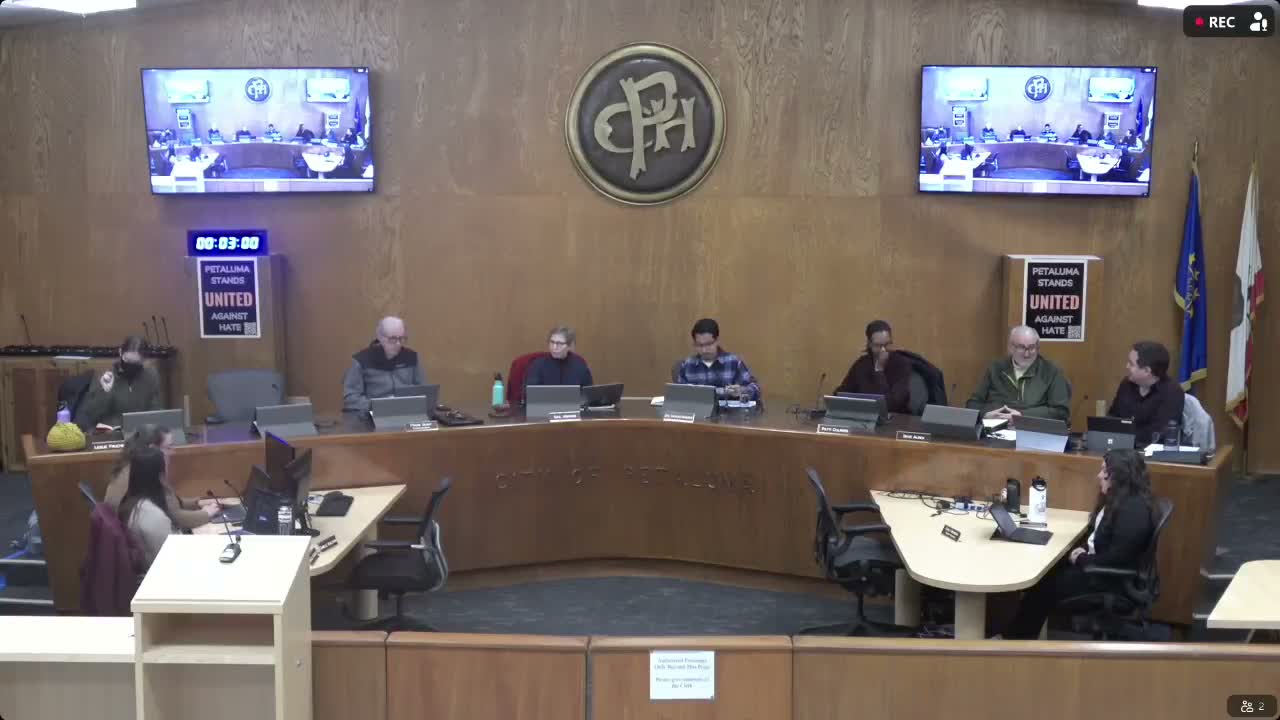
Petaluma Transit staff on Feb. 17 presented a package of service changes designed to reduce an estimated multi‑year shortfall and better align operating costs with revenue streams.
Transit Manager Jared Hall and staff framed the proposals as a combination of savings and new revenues: eliminating Sunday service across modes, ending most weekday evening service by 7 p.m., trimming selected peak trips (notably on Route 24), pausing driver hiring, restarting advertising revenue, and aggressively pursuing grants. “We’re trying to strike several balances here,” Hall said, describing the timeline that must feed the city budget and an April workshop with City Council.
Why it matters: staff said the transit system faces persistent deficits through FY 2029 unless changes are made. Camille (staff) told the committee the city is requesting an estimated $3.3 million in TDA funds and roughly $600,691 in STA this year, but she said those dollars plus prior‑year reserves still leave an operating gap that the recommended package would substantially reduce. Camille added the staff analysis includes both direct service costs and “soft costs” such as fuel and parts to make route‑level numbers add up more realistically.
Major proposals and projected impacts
- Eliminate Sunday service across fixed route, paratransit and microtransit; staff estimated combined annual savings of roughly $63,000 to $122,000 depending on assumptions. - End evening service by 7 p.m. across routes, saving an estimated $57,000 to $125,000 annually. - Remove selected peak trips on higher‑cost routes (Route 24 peak trip eliminations estimated to save $28,000–$62,000 per year). - Pause or eliminate LumiGo (microtransit). Staff described LumiGo as one of the largest line‑item costs (roughly $420,000 per year in gross operating cost under current assumptions); staff noted the service has programmatic software and administrative costs that make it expensive to operate without grant support.
Staff also outlined options to retain portions of some routes: Route 10, a low‑ridership corridor, is a candidate for full elimination, peak‑only operations, or converting to a minimal school‑tripper (one AM and one PM trip) to maintain student access while cutting middle‑of‑day service.
Committee concerns and next steps
Committee members repeatedly pressed staff to narrow wide savings ranges and explain the method used to allocate variable and fixed costs to individual routes. One committee member said the ranges were so broad they were not helpful: “Presenting that range with the lower end that’s almost certainly wrong doesn’t seem very helpful,” the member said, urging staff to rely on a best estimate plus a modest margin. Staff responded that the range comes from allocating variable costs across system hours and that, based on experience, the true savings would likely sit toward the mid‑to‑high side of the range.
Public commenters raised equity and coordination concerns. Ben Peters warned that cutting nighttime service could leave some riders without late‑hour options, and urged maintaining at least school‑serving trips on Route 10 while coordinating with Sonoma County services and the SMART train.
The committee gave staff direction to prepare a tightened, more precise three‑year proposal for the March meeting and directed staff to present clear summary tables for council. Members also signaled informal consensus around keeping a minimal Route 10 school‑tripper or peak service rather than full daytime service, while asking staff to analyze a limited Saturday pilot for Route 24 daytime service.
What’s next: staff will return with a tightened set of numbers and a recommended package for the City Council workshop; the committee endorsed pursuing the more aggressive three‑year scenario as the prudent planning baseline. Any changes must be formally adopted by the City Council before service reductions take effect.