Get Full Government Meeting Transcripts, Videos, & Alerts Forever!
Get email alerts on the Transportation Wayfinding topic
No spam. Unsubscribe anytime.
Petaluma advisory committee backs draft RFP for citywide walking and biking wayfinding; $220,000 earmarked for design and installation
Summary
The Petaluma Pedestrian & Bicycle Advisory Committee reviewed a draft RFP to hire a consultant to design a citywide active-transportation wayfinding system, discussed sign types, vandalism and maintenance requirements, QR-code map integration, and recommended a phased rollout; staff aims to issue the RFP the week after the meeting and make a decision the week of March 16.
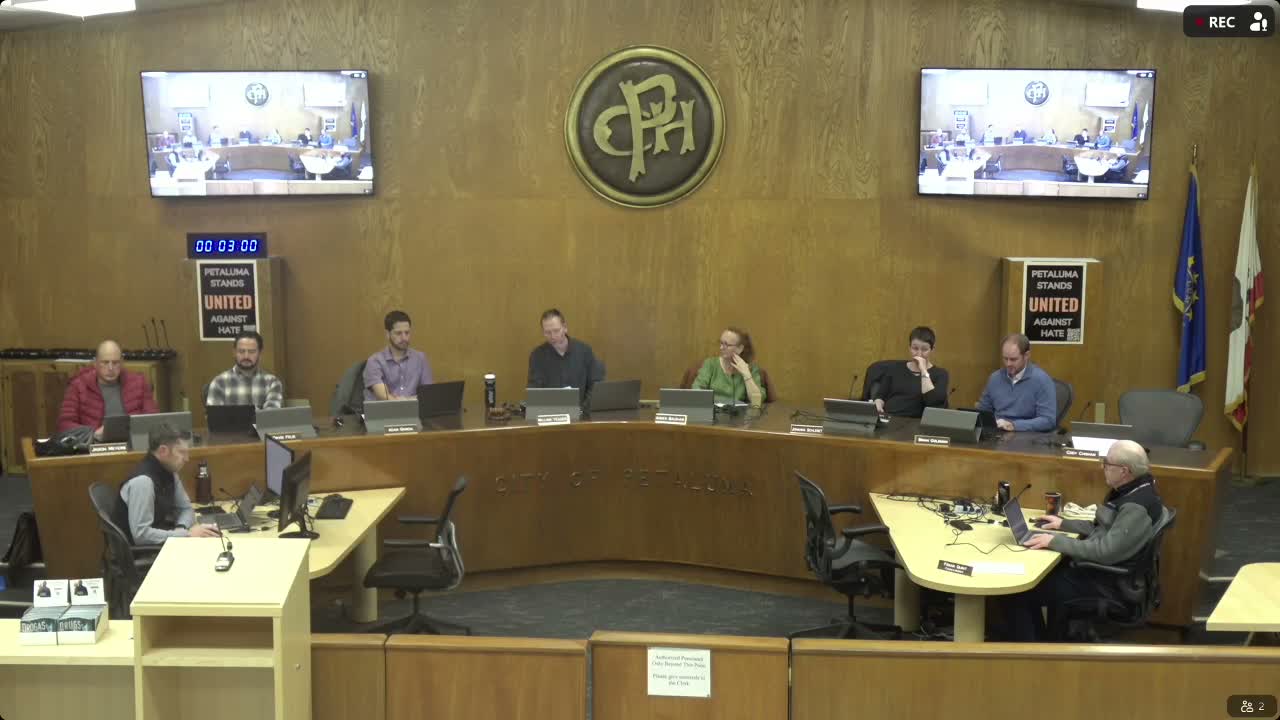
The Petaluma Pedestrian & Bicycle Advisory Committee on Feb. 4 reviewed a draft request for proposals to hire a consultant to produce a citywide active-transportation wayfinding system, a project staff said could use up to $220,000 for design and installation.
"We do have about up to $220,000 for this effort for both design and construction," said Bjorn Griebenberg, the committee’s staff liaison, who led the presentation and detailed the scope and timeline. He told members the funds come from the Transportation Development Act, Article 3, and any unused balance could carry over to other bicycle and pedestrian projects.
The RFP asks consultants to develop templates and a plan for four sign types — decision signs that list nearby destinations and walking/biking time estimates, confirmation signs placed after decision points, ground markings for shared trails and transitions, and trailhead/map kiosks — and to deliver bid-ready documents and a placement plan that staff can phase into city projects.
Committee members and public commenters pressed staff on durability, vandalism and maintenance. "There's been so much graffiti out there, and, unfortunately ... I've even seen it too on the smart pathway in town where some of their nice new wayfinding has been vandalized," Griebenberg said. He and others recommended the RFP require lifecycle guidance and specifications that make signs easier to maintain or replace.
Public commenter Bruce Hagen, a former PBAC member, urged a phased approach and said printed and electronic maps still have value. "We had about, I think, 3,000 paper maps printed," Hagen said, adding volunteer cleanup programs and simple printed maps could complement on-post signage and online maps.
Members urged the RFP to require the consultant to: identify a hierarchy of destinations (downtown, regional parks, libraries, schools and other anchors); propose phased priorities if full citywide installation is unaffordable; include modular panels so individual destination blades can be added or replaced; and incorporate features for people with limited English proficiency such as universally recognized symbols.
Several members recommended that the consultant provide before/during/after evaluation metrics and suggest how QR codes might be used to link posts to an updatable city map. Griebenberg said he expects QR codes to point to a city-maintained online map, limiting the need to replace static kiosk maps.
Committee discussion also covered sign frequency and location strategy, with members suggesting a focus on high-use corridors and low-vandalism, high-visibility placements rather than an immediate citywide rollout. Griebenberg said staff hopes to issue the RFP by the Monday following the meeting, seek a decision the week of March 16 and begin work the week of March 23. He also asked for up to two volunteers from PBAC to participate in the consultant selection process.
The committee approved the December meeting minutes with no changes earlier in the meeting; there were no formal votes recorded on the RFP during this session. The committee will collect written comments on the draft RFP through the end of the week and return suggested edits to staff.
Next steps: staff will accept edits and finalize the RFP for release, then report back on proposals and the selection schedule in mid-March.