Get Full Government Meeting Transcripts, Videos, & Alerts Forever!
Get email alerts on the Capital Projects And Funding topic
No spam. Unsubscribe anytime.
Petaluma staff outline two‑year goals, major capital projects and funding plans including $44M force‑main and public‑safety facility
Summary
City staff presented accomplishments since 2019, Measure U results, and a two‑year work plan highlighting CIP priorities: active transportation, parks and fairgrounds, Ellis Creek solar and tertiary upgrades, a $44M PIPS parallel force main, a pump station replacement, and a public safety facility; council directed follow‑up on bonds and fees.
City staff used the March 23 goals-and-priorities workshop to link Petaluma’s 2019 community vision to a near‑term work plan and to preview capital projects and funding needs for the next two years.
City Manager (Speaker 5) framed the session by noting progress on fiscal stabilization since 2019 and the role Measure U has played in rebuilding staff capacity and core services. Staff credited Measure U with improving the city’s pavement condition index, rehiring and retaining employees, advancing park and facility renovations, supporting homeless services and enabling project delivery across departments.
Key project and program highlights presented by department directors included:
- Active transportation (Paul Kaushal, Public Works): adoption of the active transportation plan, quick‑build near‑school safety projects and reduced school‑zone speed limits to 15 mph; staff said they will use paving projects to close sidewalk gaps and add bike lanes.
- Housing and planning (Brian O, Community Development): multiple projects in the pipeline (deed‑restricted affordable and market‑rate), a forthcoming draft general plan and environmental impact report, and a zoning‑code update to align regulations with the new plan.
- Parks and fairgrounds (Kat Reisinger and Drew Halter, Parks & Rec): completion of Lucchesi synthetic‑turf replacement with biodegradable infill, replastering of the Petaluma Swim Center, an outdoor educational classroom at Schulenberger Park, and a forthcoming fairgrounds master‑plan RFP.
- Water and wastewater (Chelsea Thompson, Water Resources & Utilities): Integrated Water Master Plan (IWMP) work, completion of an advanced metering program, an aquifer pilot with limited feasibility at one site, and upgrades at Ellis Creek including a 6‑megawatt floating solar array now operational; staff described a tertiary-treatment expansion to 6.8 MGD supported by a $3.6M state grant.
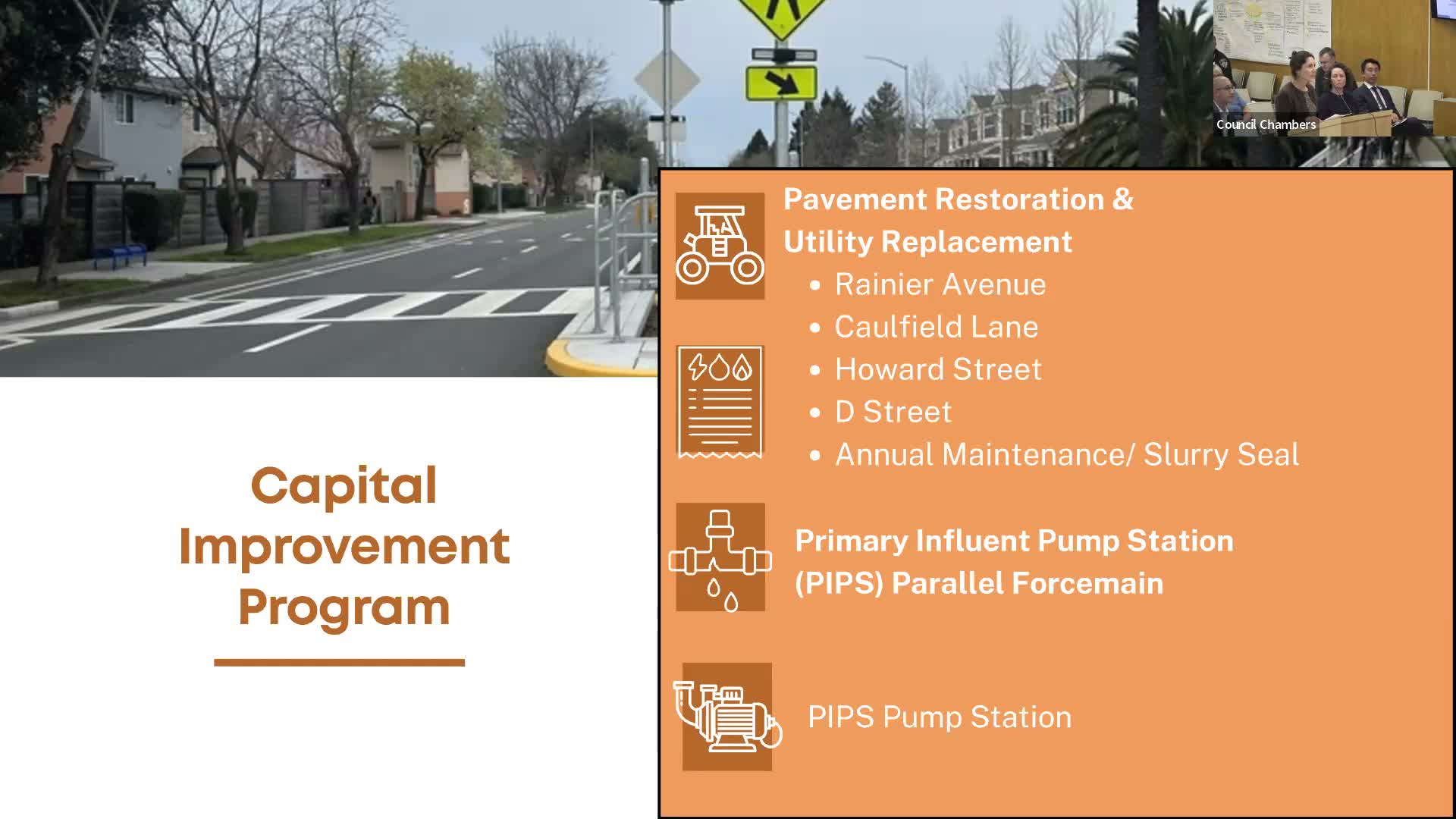
- PIPS Parallel Force Main & Pump Station: staff said the project will install a 2.5‑mile, 42‑inch HDPE parallel force main to Ellis Creek to add redundancy to an aging 1973 line. Estimated construction cost for the force main is about $44,000,000; easements and bidding are targeted this spring and summer. The PIPS pump station replacement design is estimated at $1,000,000 with construction around $24,000,000; staff indicated the city plans a wastewater bond issuance to fund these needs.
- Public safety facility and station upgrades: seismic and safety upgrades at D Street Fire Station No.1 are underway; the new public safety facility at the fairgrounds is progressing through RFQ review with a target to be under contract by summer and substantially completed by 2028.
Council and staff discussed fiscal sustainability, noting slower revenue growth and rising costs. Staff plans a revenues workshop and options for bond issuances this year (including Measure H resources and wastewater revenue bonds). The manager and finance staff emphasized that bonds will be sized to fit existing rate structures where possible.
Other operational topics raised included the city clerk’s public‑records workload (about 800 requests in 2025), the city’s adoption of an AI platform for staff use, and proposals for refining fees, inclusionary housing policy and zoning to support housing production.
What’s next: staff will return with CIP and bond proposals, fee and code‑update work tied to the general plan and a schedule for an economic‑development workshop to refine vacancy, downtown revitalization and incentive strategies.