Get Full Government Meeting Transcripts, Videos, & Alerts Forever!
Get email alerts on the Election Administration topic
No spam. Unsubscribe anytime.
Minnesota's chief election official details voter-roll safeguards to House committee
Summary
Minnesota's chief election official told a House committee that the state uses secure automatic registration, database matches (including DMV and SSA/HAVA checks), mailed non-forwardable verification postcards and annual maintenance to keep voter rolls current, and that suspected violations are referred to county attorneys.
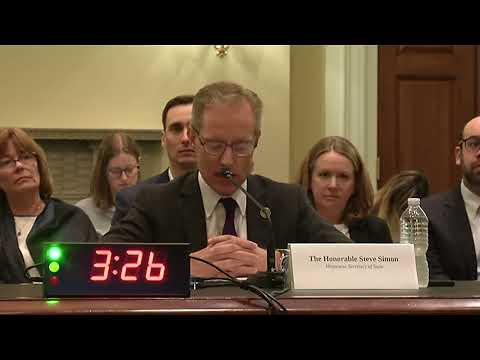
Minnesota's chief election official told members of the House Committee on House Administration that the state uses multiple overlapping procedures to keep voter registration lists accurate and up to date.
In prepared remarks, the official said Minnesota allows voter registration either through a voter-registration application or, for eligible residents, through a secure automatic voter-registration process run by the Minnesota Driver and Vehicle Services division of the Department of Public Safety. "Individuals are only eligible to be included in that system if they provide citizenship-affirming documentation, such as a birth certificate or a passport," the official said.
The state compares each registration to the Minnesota driver's license database or to the Social Security Administration's Help America Vote Act (HAVA) verification database depending on the identification number provided, he said. After a registration is added to Minnesota's Statewide Voter Registration System (SVRS), the state mails every registrant a non-forwardable postal verification card; if that card is returned as undeliverable twice, the record is inactivated.
The official described continuous, automated checks of SVRS against multiple data sets to identify ineligible or duplicate records. Those checks include monthly reports from the Minnesota Department of Corrections on people incarcerated for felony sentences, daily reports from the Minnesota court system on people whose right to vote has been revoked, monthly Department of Public Safety reports on noncitizens with temporary status, and death indices from the Minnesota Department of Health and the Social Security Administration. He also said Minnesota's system is set up to detect duplicate voter records and that the state securely shares information with 25 states and the District of Columbia to identify voters who have moved or registered in other jurisdictions.
"In the rare cases where a potential voter-registration violation is identified, state law requires referrals to the county attorney for investigation and prosecution," the official said.
The witness also described annual list maintenance that inactivates any voter record that has not been updated by voting or other registration activity in over four years, and highlighted the role of local officials: Minnesota's 87 counties, hundreds of municipalities and more than 30,000 poll workers who support election administration on election day.
The official concluded by saying public trust in the system is "exceedingly high," pointing to public-opinion polling and the state's historically high voter turnout.
The remarks were delivered in a five-minute statement to the House Committee on House Administration. No committee action or vote on these procedures was recorded in the provided transcript.