Get Full Government Meeting Transcripts, Videos, & Alerts Forever!
Get email alerts on the Voter Registration topic
No spam. Unsubscribe anytime.
House committee questions Minnesota rules on same‑day registration, vouching and noncitizen voting
Summary
A House Administration Committee exchange with Minnesota election officials probed whether state practices — including same‑day registration, vouching and automatic voter registration (AVR) — could allow noncitizens to be placed on voter rolls; state officials said AVR requires citizenship documentation and Minnesota is NVRA‑exempt.
A House Administration Committee member pressed Minnesota election officials on whether state practices could allow noncitizens to be registered and vote, citing a recent Fillmore County criminal case and asking whether driver's licenses or same‑day registration can lead to improper registrations.
The questioner, identified in the transcript as "G MEMBER," asked whether noncitizens should be voting in U.S. elections and whether Minnesota issues driver's licenses to undocumented immigrants. Both panelists on the record answered in the affirmative that noncitizens should not vote; the exchange then focused on how Minnesota's systems operate.
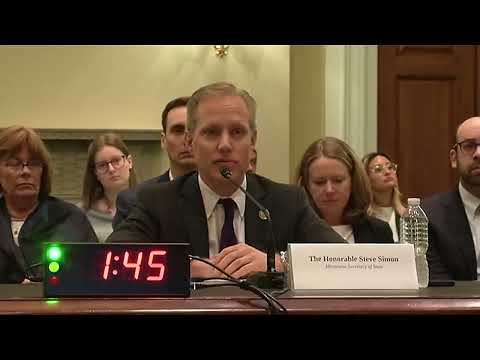
Secretary Simon, who appears in the transcript as "Secretary Simon," said Minnesota does not indicate citizenship on a driver's license and confirmed the state allows same‑day registration. "Yes, it's not required," Simon said when asked whether photo identification is required for same‑day registration, adding that vouching procedures permit a registered voter to vouch for others' residence but not their citizenship. Simon noted that vouched individuals must live in the same precinct and must swear an oath before being registered.
The committee member cited a Fillmore County matter in which an individual was charged with voting illegally after obtaining a driver's license and receiving voter registration materials. Simon disputed the framing of the specific news report the member flagged and described Minnesota's process: the state is NVRA‑exempt and uses a back‑end automatic voter registration (AVR) system. "We have a back end AVR automatic voter registration system, and the only folks who are eligible to even be in the pile to be considered to be registered to vote are those who produce citizenship affirming documentation at the time they apply for that ID," Simon said, adding examples including naturalization papers, a birth certificate or a passport.
Committee members asked whether Minnesota could use a shared federal database that some officials said had been made available. Simon said Minnesota had evaluated that database but had determined it was "not yet ready for use" and that adopting it would require a statutory change under Minnesota law.
Secretary Schwab, also on the panel, emphasized practical data problems that can leave deceased people on voter rolls and the county effort required to clean records. "Nobody wants a person who's deceased on their voter rolls," Schwab said, describing cases in which people die in other states and the state must rely on county follow‑up to update records.
The hearing excerpt ended with the committee moving on to timing and procedural matters. No formal action or vote on changes to Minnesota law is recorded in this portion of the transcript.