Get Full Government Meeting Transcripts, Videos, & Alerts Forever!
Get email alerts on the Surveillance Privacy topic
No spam. Unsubscribe anytime.
Petaluma advisory committee splits after public outcry over Flock ALPR; asks council to study alternatives
Summary
After more than two hours of public comment and technical Q&A, Petaluma dvisory Committee voted to ask the city council to evaluate alternatives to the Flock automatic license plate reader (ALPR) service, declined to recommend immediate suspension or termination, and recorded a recommendation that the city attorney continue contract review.
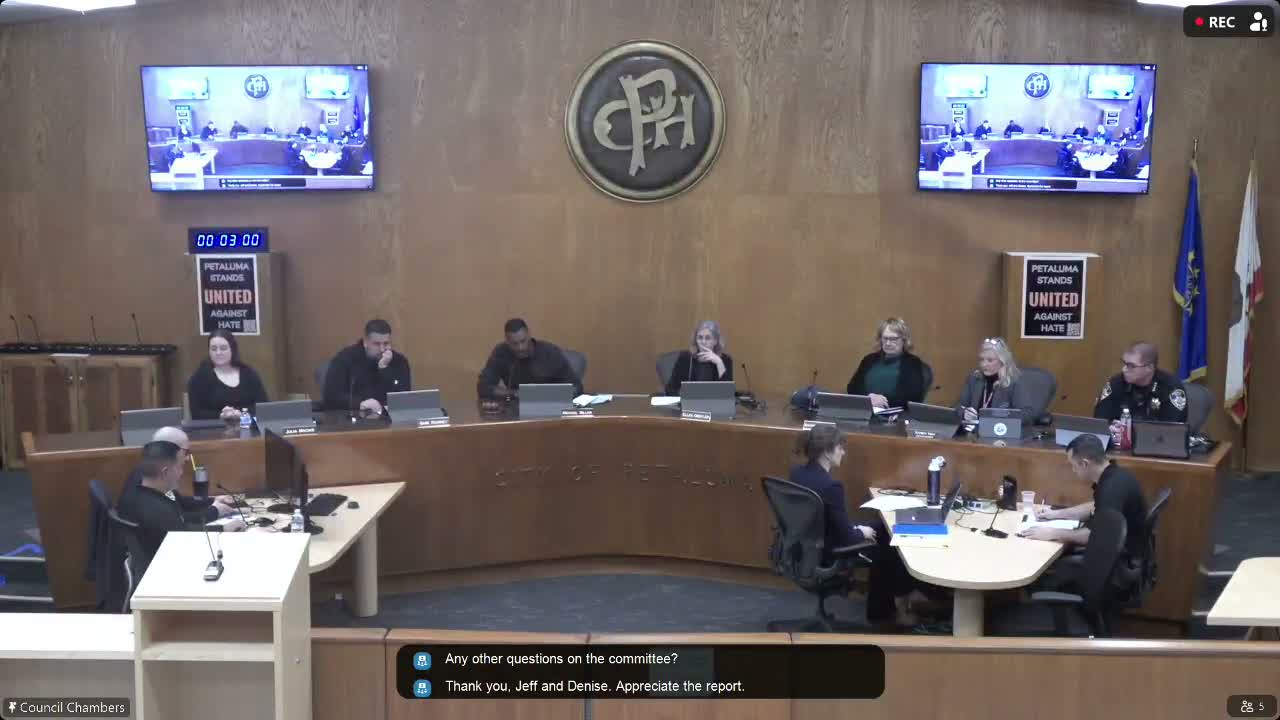
Chair Miller convened the Public Safety Advisory Committee on Feb. 25 to review the City of Petaluma LPR program and its contract with vendor Flock following weeks of public concern.
The meeting featured a lengthy public comment period in which at least two dozen residents urged the committee to ask the city council to cancel the Flock contract and remove Flock cameras. Speakers cited security vulnerabilities, public-record disclosure of ALPR searches, and the risk that regional fusion centers could share data with federal agencies. "These cameras are not just dangerous, they're un American," said Robin Riley, a longtime Petaluma resident and volunteer organizer, summarizing the distrust expressed by multiple commenters.
Petaluma Police Chief Miller detailed the department's approach: the city owns four fixed Flock cameras (the department said other cameras in the area may be privately owned), staff have posted a transparency webpage and updated the ALPR policy, and staff deactivated data sharing with El Cajon after litigation raised compliance concerns. Chief Miller said the vendor has made platform changes (including measures to disable out-of-state sharing by default) and that the city attorney is negotiating contract revisions intended to clarify that the city retains ownership of its ALPR data.
Deputy Chief McGowan explained what the city provides in response to Public Records Act (PRA) requests: the date, time, agency identifier and query type for ALPR accesses; the city also supplies monthly audit logs showing which agencies accessed the system. The city attorney summarized the PRA review process and said some data tied to active investigations or that contains identifying information may be redacted or withheld as allowed by law.
Public commenters cited technical reports and local precedents. Isaac Russo referenced a white paper that lists security vulnerabilities in Flock devices; Nicholas Huggins, information-technology director for the federal public defender, warned that ALPR data have been linked to misidentifications and wrongful arrests elsewhere. Several speakers pointed to recent municipal actions, including Mountain View and Richmond, as examples of jurisdictions limiting or suspending Flock use.
After public testimony and staff responses, Chair Miller proposed three separate recommended actions for the city council: (1) continue additional contract review by the city attorney nd staff; (2) evaluate alternatives to the Flock service contract, including different contractors or local/non-cloud storage models; and (3) consider termination or suspension of the contract pending further study. The committee voted to recommend that the council evaluate alternatives (motion carried, 4 yes, 2 no). The motion to recommend termination or suspension of the contract failed on a 3-3 tie. A separate recommendation to continue the city attorney—ontract review was advanced to the council.
Chair Miller emphasized that PSAC can only advise the city council and does not have authority to cancel or suspend contracts. Committee members and staff said any policy or contract decisions will return to the council for formal direction. The committee also agreed to push the next agendized item to next month's meeting and adjourned at 7:41 p.m.
What happens next: The PSAC will forward its recommendations to the city council; the council may direct additional legal review, request studies of alternatives, or take other action. Members of the public were encouraged to submit written comments to the city clerk and attend upcoming council meetings where final authority rests.