Get Full Government Meeting Transcripts, Videos, & Alerts Forever!
Get email alerts on the Transportation Infrastructure topic
No spam. Unsubscribe anytime.
Petaluma council awards $2.88 million Rainier Avenue paving contract after safety-focused debate
Summary
The Petaluma City Council approved a construction contract for the Rainier Avenue pavement restoration project and amendments to capture design-immunity protections, approving Argonaut Constructors’ low bid while discussing safety features, parking impacts and a midyear budget adjustment to cover a roughly $3.6 million project budget.
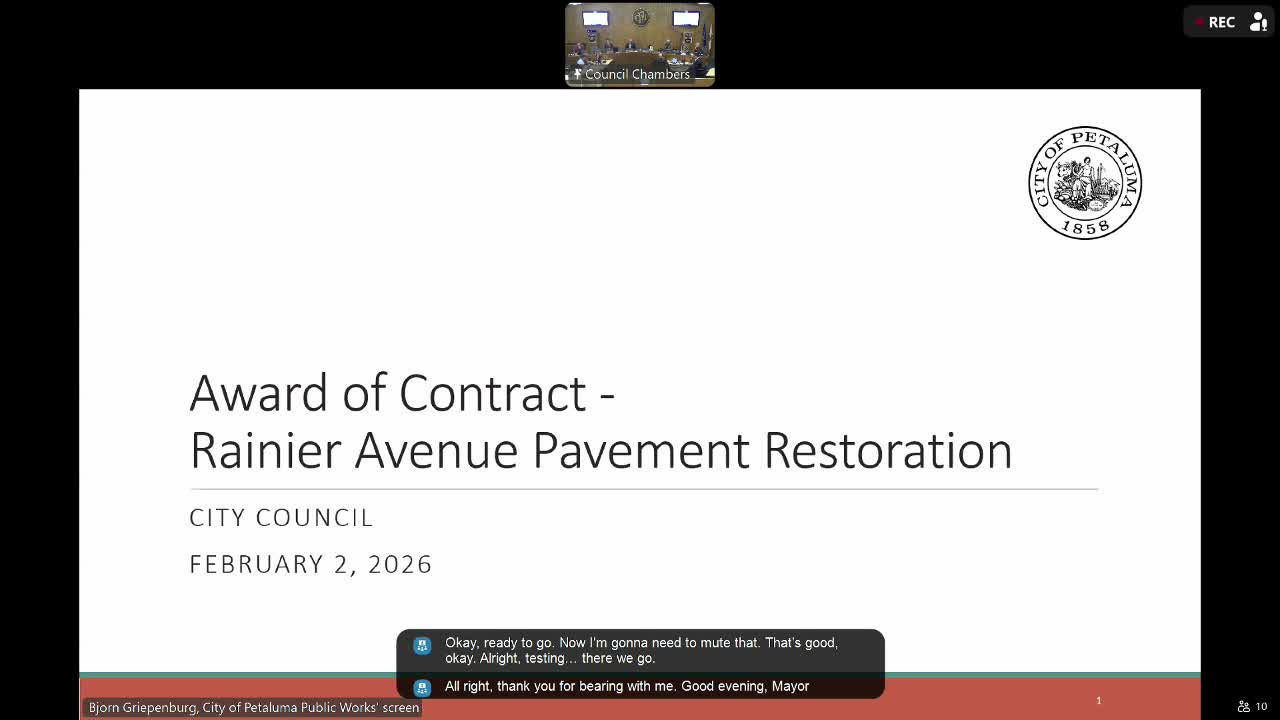
Petaluma — The City Council voted Feb. 2 to award a construction contract for the Rainier Avenue pavement restoration project to Argonaut Constructors, approving the award after a lengthy staff presentation and public comment on safety, parking and budget implications.
Bjorn Grepenberg, the city’s transportation planner, told the council the project covers Rainier Avenue from North McDowell Boulevard to Snow Mountain Parkway and builds on an earlier pilot that converted a westbound segment from two lanes to one. "Paving projects represent crucial once in 20 plus year opportunities to make significant design changes to our streets," Grepenberg said, and he cited pilot survey results showing the converted segment produced higher compliance with the 35-mile-per-hour limit and "no injury collisions in that section" for more than three years.
Staff said six firms bid on the construction contract; the engineers’ estimate was about $3 million and the recommended award was "just shy of $2.9 million". The staff report and presentation list an updated total project budget in the neighborhood of $3,600,000, which includes design, a proposed $300,000 contingency and the recommended construction award. Grepenberg summarized key design elements the project will deliver: a 4-to-3 lane conversion with a dedicated left-turn lane, protected bike lanes (with an asphalt curb on the eastbound side), new crosswalks and flashing beacons, an approximately 800-square-foot bioretention area and a roundabout at the Maria Drive intersection.
Council members questioned operational details and tradeoffs. Council Member Schrips pressed staff on non-price factors in selecting a contractor and whether small bid differences would be outweighed by potential change orders; staff said the low bidder had completed comparable work for the city and the CIP team vetted the bids. Council Member Quint asked whether lane reductions would cause congestion; Grepenberg said "not from what we've seen," citing Federal Highway Administration guidance that lane conversions are appropriate on roads carrying well under the FHWA’s 18,000–20,000 vehicles-per-day threshold (Rainier carries about 4,300 vehicles per weekday). On maintenance and construction sequencing, staff said prior utility work (recycled water and water-service replacements) had already been completed and the paving contract is focused primarily on roadway reconstruction.
Nearby residents and neighborhood groups offered mixed views during public comment. Sandra Martinez, who lives on Maria near the project, urged the council to "make some serious and thoughtful consideration for the people who live on Maria and Rainier" and warned that removing parking could "permanently change how we use our homes." Supporters including representatives of Safe Streets Petaluma and the Sonoma County Bicycle Coalition said the design would slow traffic and improve safety for people who walk and bike. "Stand by your plan," a Safe Streets volunteer told the council.
Budget oversight and project costing drew focused criticism from public speakers and some council members. Resident Darren Rakusen flagged the project table in the staff report and said project administration and overhead figures had "nearly tripled," raising questions about project accounting and the shift in funding sources toward bond proceeds. In response, a city finance/staff representative said there had been "no change in practice or policy about how we charge projects" but that the city had re-estimated administrative costs to better match actuals and avoid large variances at closeout; staff also explained the city’s practice of bundling midyear budget adjustments into scheduled ordinance-based amendments.
The council also approved a proposed addition to the resolution to include a staff memo and recital intended to secure design-immunity protections under state law; the city attorney framed the amendment as adding the factual record needed to take advantage of Government Code protections for design decisions.
Council Member Quint moved the amended resolution awarding the contract; Council Member Barnacle seconded. On roll call the motion carried with five votes in favor, one no (Vice Mayor DeCarly) and one recusal (Council Member Kate Thompson). The clerk recorded Barnacle, Nao, Quint, Shribbs and McDonnell as yes; DeCarly voted no; Thompson recused herself because she lives within 500 feet of the project. The staff presentation said construction could begin in mid-March with anticipated completion in late summer 2026, and staff said they will post construction updates and resident notifications on the city website (cityofpetaluma.org/rainierpaving).
What happens next: Council approved the contract award and the design-immunity recital; staff will bring a midyear budget adjustment to the council to align funding to the updated $3.6 million project estimate before issuing a notice to proceed. The resolution as approved directs staff to include the city attorney’s memo in the project record and to proceed with the contract award process once the contractor submits required documents.
Costs and funding: Staff stated the recommended construction award to Argonaut Constructors was approximately $2,884,000 and that the overall project budget is ~ $3,600,000 including contingency; staff said the midyear budget adjustment will identify the specific funding sources (staff discussion referenced Measure U bond capacity and a shift in funding tables in the staff packet).