Get Full Government Meeting Transcripts, Videos, & Alerts Forever!
Get email alerts on the Parks Recreation topic
No spam. Unsubscribe anytime.
Sunrise Rotary proposes bocce courts at McNear Park; commissioners press for alternatives to artificial turf
Summary
The Petaluma Recreation, Parks and Music Commission heard a Sunrise Rotary Club concept to replace six horseshoe pits at McNear Park with bocce courts. Commissioners and residents praised the concept but pressed staff to explore alternatives to artificial turf, address tree relocations, shade and drainage before returning with design and cost details.
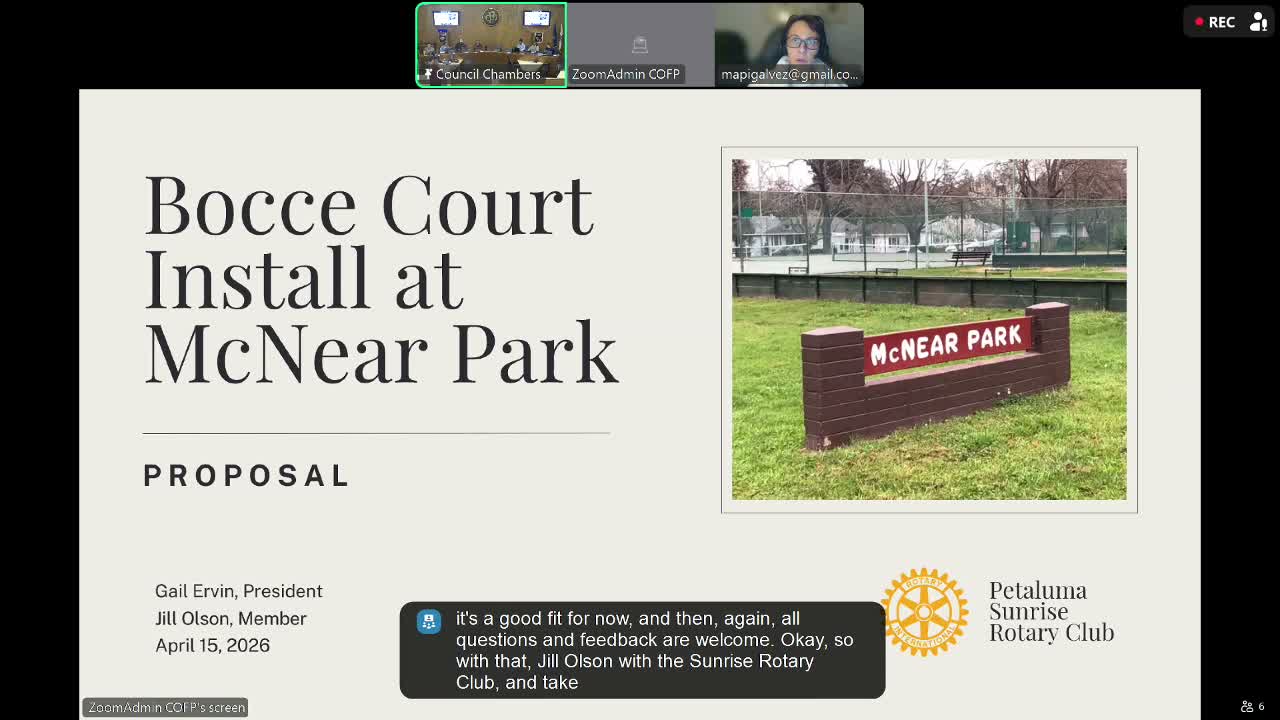
Petaluma — The Petaluma Recreation, Parks and Music Commission on April 15 heard a concept from the Sunrise Rotary Club to replace six underused horseshoe pits at McNear Park with six bocce courts.
Jill Olsen, a member of the Petaluma Sunrise Rotary Club, told the commission the site offers 20 off‑street parking stalls (two accessible), room for six courts, and space for a 6‑by‑8 storage shed to house balls and umbrellas. The club proposed a low‑maintenance surface — a putting‑green style turf with no infill — two ADA‑accessible courts, and organized league play in spring and fall with open play outside those hours. "It's a very popular sport and we are underserved with courts in this community," Olsen said.
The proposal rests on a concept level; staff asked the commission whether the idea merits additional study and design work rather than seeking formal approval tonight. Commissioners and several residents expressed broad support for converting an underused amenity but repeatedly urged staff and the Rotary to explore alternatives to artificial turf and to address potential impacts on existing horseshoe users and park trees.
"Artificial turf is not a no maintenance surface by any means if you want it to perform properly," the chair said, urging staff to evaluate sand, decomposed granite or polymer‑stabilized surfaces. Commissioner Stacy added concerns about infill and children's exposure: "Even though it's cork, [the infill] is not great for kids," she said, citing prior commission discussions on synthetic materials.
Olsen described maintenance tradeoffs and said a turf putting‑green with no infill would reduce Rotary and city maintenance needs; she estimated a typical life span for the turf product at about 15 years and proposed that the Rotary or a city maintenance agreement would cover replacement when needed. She also described operational details: league nights two to three evenings per week for about six weeks, an estimated 36 active players at a time, and no lighting for night play.
Commissioners asked whether horseshoe players would be displaced. Staff and Olsen said two horseshoe pits could be relocated to the north side of the tennis courts so horseshoe play could continue; staff noted reservations for horseshoes have been rare in recent years. Trees planted since 2018 may need relocation — Olsen said Rotary would coordinate with the city's tree staff — and commissioners asked for drainage plans, shade solutions and clear rules for reserving courts.
Public commenters who supported the project said bocce is age‑friendly and draws a mix of players. Marion Wagner described a successful conversion elsewhere: "We took out two [horseshoe pits] and put in bocce ball courts, and they have been a huge draw."
Staff asked commissioners for specific data and design issues they want addressed when the project returns for formal review. Next steps: staff will package the feedback, investigate surface alternatives and drainage, and bring a refined design and cost estimate back to the commission; no funding or formal recommendation was approved at the meeting.
(Reporting in this article is based on the commission's April 15 meeting; quotes and details come from speakers at that meeting.)