Get Full Government Meeting Transcripts, Videos, & Alerts Forever!
Get email alerts on the Stadium Funding topic
No spam. Unsubscribe anytime.
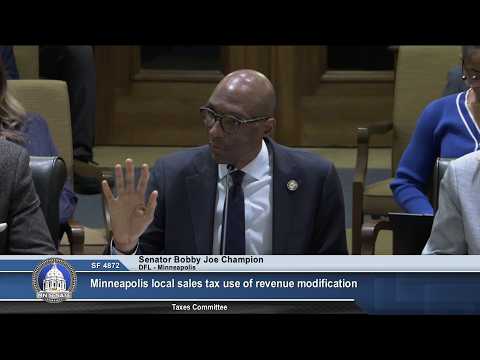
Sen. Champion urges repurposing downtown sales tax captured for U.S. Bank Stadium; city officials give fiscal estimates
Summary
Senate File 48‑72 would strike language requiring the commissioner to retain certain downtown sales tax revenues for the Minnesota Sports Facilities Authority and modify the downtown taxing area; sponsor and city witnesses said doing so would eliminate a projected $62 million 'fourth tranche' to the Authority while leaving other city stadium obligations intact.
Senator Champion introduced Senate File 48‑72 to the Senate Taxes Committee, asking lawmakers to remove statutory language that directs certain excess downtown sales tax revenues to the Minnesota Sports Facilities Authority and to expand the downtown taxing area to include the North Loop effective Sept. 30, 2026. He said the bill does not change the city’s existing obligations to repay construction bonds or its capital‑improvement commitments to U.S. Bank Stadium.
Champion said the City of Minneapolis remains obligated for $150 million in construction‑related commitments and currently contributes roughly $6.6 million annually into the state general fund tied to stadium arrangements. He described an additional revenue stream—the so‑called "fourth tranche" of excess sales tax captured downtown—and estimated that under current law the city would be required to contribute roughly $50 million to $80 million of that revenue to the Minnesota Sports Facilities Authority through 2046.
Angie Skilled, director of Development Finance and Property Services for the City of Minneapolis, testified that eliminating the fourth tranche would save about $62 million in payments starting in 2027, while the city would continue to be responsible for other contractual capital and operating obligations related to the stadium. "If that fourth was eliminated, starting in 2027 that would save about $62 million dollars in payments going forward," Skilled told the committee, while stressing the city’s continuing obligations for capital improvements and bond repayments.
Councilmember Michael Rainbow of Minneapolis’ Ward 3 testified in support of adding the North Loop to the downtown taxing area in order to align the captured area with current downtown activity and to equalize tax treatment for businesses that are a few blocks apart. He said the city will continue to honor capital and operating commitments to the stadium even if the fourth tranche is removed.
Multiple senators pressed for clarity on what the fourth tranche paid for and on historical uses. Sponsor and committee members revisited prior changes made in 2023, which narrowed how Authority‑captured revenues could be used, and discussed concerns about accountability and the economic shifts in downtown Minneapolis. Champion repeated a committee claim that downtown commercial property values had declined roughly 20 percent and argued that relying on the fourth tranche to support the Sports Facilities Authority could shift costs onto local taxpayers.
The bill also includes a one‑time appropriation of $7 million in fiscal 2027 from the general fund for Explore Minnesota to support PGA Championship event costs in Chaska, and a cancellation paragraph that reduces an existing general fund appropriation by roughly $5.967 million (as described by the sponsor’s summary to the committee). Champion emphasized that most existing obligations tied to stadium bonds and capital contributions remain unchanged by this bill.
What happens next: the author and fiscal staff will provide follow‑up technical detail at the committee’s request, and committee members requested additional documentation clarifying which specific obligations are covered by statute versus interparty agreements. No final committee vote on the bill’s substantive provisions was recorded in the hearing transcript; the committee laid the bill over for further consideration.
Sources: Testimony and sponsor remarks before the Senate Taxes Committee, Senate File 48‑72 proceeding (transcript segments beginning SEG 010 through SEG 743).