Get Full Government Meeting Transcripts, Videos, & Alerts Forever!
Get email alerts on the Land Use topic
No spam. Unsubscribe anytime.
Planning commission recommends approval of smart-greenhouse manufacturer with conditions
Summary
The Syracuse Planning Commission voted to recommend approval of a special-use permit for a 3,700 sq ft smart-greenhouse manufacturing facility at East Genesis Street, approving a related resubdivision and issuing a negative SEQR declaration. The recommendation to the Common Council includes conditions limiting outdoor operations, requiring noise/air plans, and locking the use to greenhouse manufacturing.
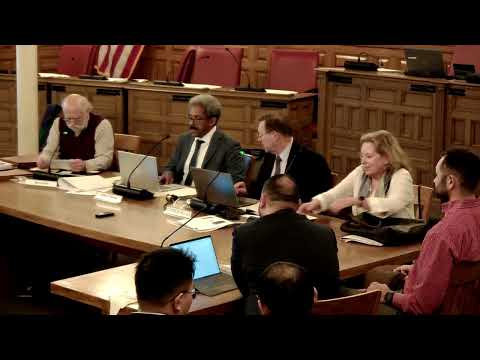
The Syracuse Planning Commission on March 16 recommended that the Common Council approve a special-use permit for a proposed smart-greenhouse manufacturing facility at 2956, 2960 and 2964 East Genesis Street.
Ashoke Bose, who introduced himself as the project founder and said he represents Sustainable Energy and Agriculture Technology (SC80), told the commission the 3,700-square-foot facility would develop and assemble smart-greenhouse systems designed to combine greenhouse engineering with sustainable energy technologies. Bose said the operation would be fully indoors and that the project aims to support neighborhood revitalization and local clean‑tech jobs.
Commissioners reviewed the environmental assessment (EAF Part 1 and staff-prepared Part 2), determined the action would not have a moderate-to-large environmental impact and adopted a negative SEQR declaration. The board approved the companion resubdivision (R-25-34) with a condition that the applicant file the map with the county clerk within 62 days of special-use approval.
The commission’s recommendation on Special Use Permit SP-25-20 includes eight specific conditions intended to address neighbors’ concerns: operations must be conducted entirely indoors; no outdoor material processing or storage; landscaping must be installed as shown on the site plan; loading and unloading must be limited to designated areas and not occur in the public right-of-way; the applicant must implement the submitted loading/unloading, air-quality control and noise-control plans; the permit is granted only for greenhouse-manufacturing (manufacturing general) and changes that increase operational intensity will require additional review; modifications to manufacturing equipment or intensity require additional zoning review; and the business must follow hours set by the Planning Commission and Common Council.
Neighbors voiced opposition during public comment, saying recent zoning amendments would no longer allow such a use at the site and that the location is incompatible with surrounding residential areas. Donna Stoner and Louise Magnarelli told the commission they appreciated the applicant’s engagement but remained opposed to granting an exception. The commission’s conditions are intended to constrain intensity and protect surrounding streets and nearby Nottingham High School from traffic and noise impacts.
Next steps: the commission’s decision is a recommendation. The Common Council will take final action and may attach additional conditions or modifications.