Get Full Government Meeting Transcripts, Videos, & Alerts Forever!
Get email alerts on the General Plan topic
No spam. Unsubscribe anytime.
Petaluma Planning Commission recommends final EIR and advances updated general plan to City Council
Summary
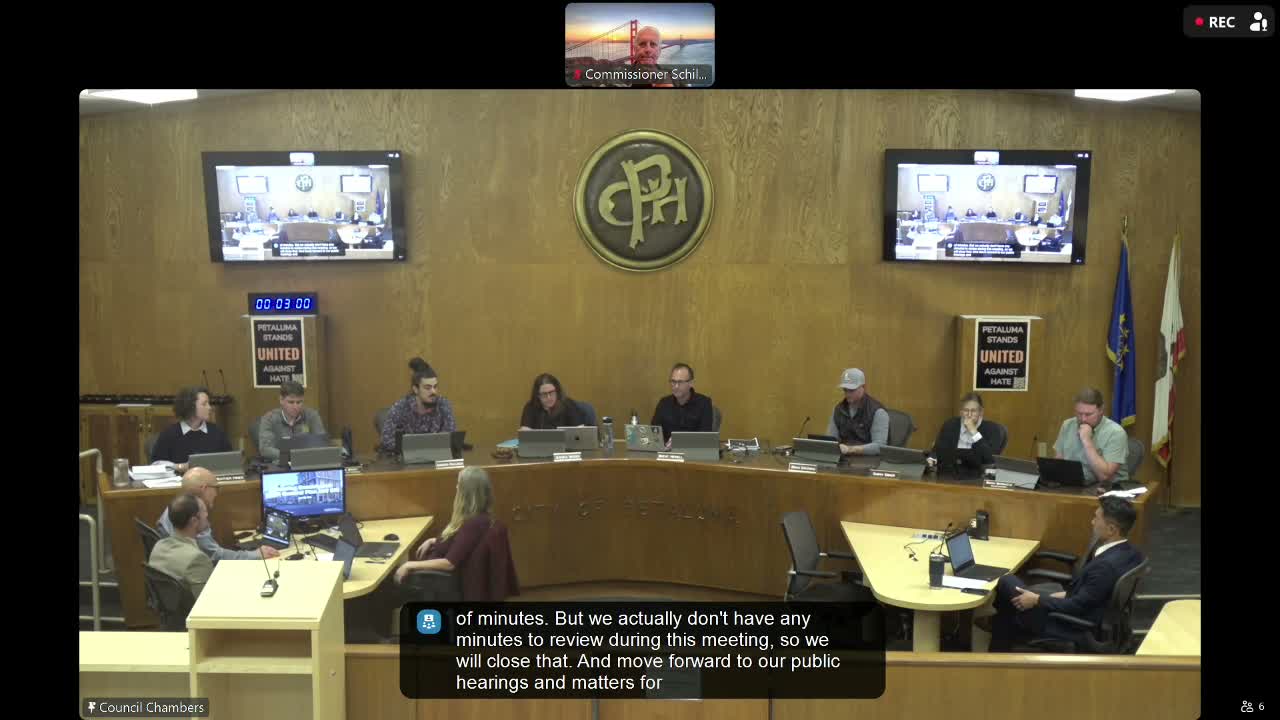
After a public hearing on April 28, the commission voted unanimously to recommend that the City Council prepare a final environmental impact report for the draft Petaluma General Plan and, upon certification of the final EIR, adopt the new general plan and rescind General Plan 2025.
The Petaluma Planning Commission voted unanimously on April 28 to recommend that the City Council prepare a final environmental impact report (EIR) for the draft Petaluma General Plan and, following certification of that final EIR, adopt the updated general plan and rescind the city’s General Plan 2025.
The two resolutions the commission endorsed will move as recommendations to a City Council hearing tentatively scheduled for May 18. The vote followed a staff presentation, a technical review of the draft program-level EIR, a lengthy question-and-answer session among commissioners and staff, and a public comment period that included residents and members of the general plan advisory committee.
Ron Whitmore, a principal with Ramey and Associates and Alta Planning + Design, opened the staff presentation and summarized the five-year update process and community outreach. "We heard from thousands of city residents," Whitmore said, describing outreach activities and the coordination of the adopted housing element and the city’s climate blueprint with the draft plan. Staff detailed implementation actions already underway, including the zoning code update, the Petaluma North Station specific plan and a Central Petaluma specific plan kickoff.
Olivia Urban, a principal environmental planner, framed the EIR as a program-level CEQA document designed to disclose environmental consequences and inform decision-making. "CEQA is a public disclosure and public input process," Urban said, and she explained that the draft EIR evaluates impacts at a broad level and anticipates the need for subsequent project-level review in many cases.
Consultants and staff identified several categories of significant and unavoidable impacts at the program level, most notably potential impacts to cultural and historic resources, greenhouse gas emissions and transportation-related vehicle miles traveled (VMT), and short-term construction noise. Matt Maddox of Rincon Consultants summarized why the EIR reached those conclusions: the city cannot now guarantee that every future private development or infrastructure project will avoid impacts to historic resources across a 25-year buildout; state limits on local authority over building regulations mean greenhouse-gas reductions in the plan cannot be guaranteed; and regional commuting patterns make it difficult for Petaluma alone to demonstrate the reductions in VMT required by state thresholds.
Commissioners pressed staff on several technical points. Commissioner Rakusen asked which build-out numbers the EIR used; staff explained that the cumulative analysis reflects a larger regional growth assumption (6,449 residential units and 1.4 million square feet of nonresidential development), while the net change associated directly with the proposed land-use changes is smaller (about 2,400 new residential units and roughly 708,000 square feet of nonresidential development). Staff also explained that a citywide historic-resources inventory is useful but, at the program level, cannot by itself be relied on to reduce the EIR’s findings to less-than-significant because inventories can quickly become out of date across a 25-year horizon.
Public comment reflected both support and caution. Robin Riley, a member of the General Plan Advisory Committee, praised the document’s public-driven process and noted a potential library relocation to North Petaluma that the plan’s North Station mixed-use designation could support. Veronica Olson, a community lead who spoke in favor of transit-focused growth, questioned the assumption that 8–11–story station-area buildings are the most effective means to deliver housing and climate outcomes: "What actually gets built? Not what we hope gets built," Olson said, urging the city to focus on deliverable building forms.
After a brief recess, the commission considered two resolutions recommended by staff: (1) direct staff to prepare a final EIR that responds to written and oral comments, and (2) recommend that City Council, after certification of the final EIR, adopt the general plan and rescind the General Plan 2025. Commissioner Rakusen moved the first resolution; Commissioner Goldman seconded. The clerk recorded aye votes from Commissioners Abner, Goldman, Newell, Rakusen, Schilt, Council member Barnickel and Chair Moses; the motion passed 7-0. Commissioner Newell moved the second resolution and Council member Barnickel seconded; the commission again voted 7-0 to approve the recommendation.
What happens next: staff will assemble public comments and prepare a final EIR (the record of comments and responses). The final EIR and the planning commission’s recommendation will be forwarded to City Council for consideration at the May 18 meeting. Staff and commissioners encouraged continued public engagement in subsequent code and implementation phases, including the zoning code update, mitigation monitoring and report programs, and the North Station and Central Petaluma specific plans.
Votes at a glance
• Resolution 1 (prep. final EIR recommendation): Mover — Commissioner Rakusen; Second — Commissioner Goldman; Vote — Abner (Aye), Goldman (Aye), Newell (Aye), Rakusen (Yes), Schilt (Yes), Barnickel (Aye), Chair Moses (Yes); Outcome — approved (7–0).
• Resolution 2 (recommendation to Council to adopt general plan upon certification and rescind General Plan 2025): Mover — Commissioner Newell; Second — Council member Barnickel; Vote — same roll call; Outcome — approved (7–0).
Why it matters
The commission’s recommendation advances a comprehensive, community-driven update to Petaluma’s long-range land-use framework and begins the CEQA conclusion needed before City Council can consider formal adoption. The draft EIR’s identification of program-level significant and unavoidable impacts—particularly for cultural resources, greenhouse gases and transportation—frames the principal environmental trade-offs the city will need to manage during implementation and future project reviews.
Next steps and public input
Staff will prepare the final EIR, including responses to comments filed by May 18, and will place the final documents and the commission’s recommendation before City Council at the May 18 hearing. Implementation actions such as the zoning code update and specific plan work are expected to continue in parallel; the commission urged continued community engagement during those phases.