Get Full Government Meeting Transcripts, Videos, & Alerts Forever!
Get email alerts on the Commercial Energy Code C406 topic
No spam. Unsubscribe anytime.
MVPE committee forwards competing C406 credit packages to Council for rulemaking
Summary
After extended technical debate over PNNL modeling, baselines and east/west weighting, the MVPE committee directed staff to include PNNL modeling files in the CR102 package and forwarded two competing sets of C406 credit requirements (the David Reddy and Gregory Johnson proposals) to the Council for public comment and final decision.
In a lengthy virtual session of the MVPE advisory committee to the Building Code Council, members voted to forward PNNL’s updated C406 modeling and two competing credit-requirement methodologies to the Council for CR102 rulemaking and public comment. The decision keeps competing options on the table rather than the committee choosing a single recommendation.
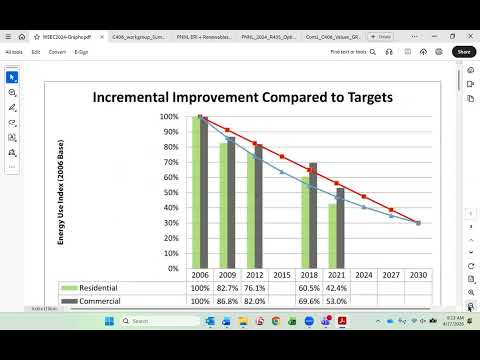
The committee’s technical discussion centered on how many C406 points different building typologies should be required to meet, how point values map to percent energy savings, and which baseline should be used to measure progress. Kjell Anderson (LMN), who helped convene practitioners and engineers to review the modeling, summarized the process: PNNL ran energy models and the workgroup play‑tested credit values; “each point in C406 is worth 0.1% energy savings,” he said, and some measures still lack modeled thresholds.
Gregory Johnson (Avista), who walked the committee through PNNL’s adjustment factors and regional differences, urged the group to accept the PNNL outputs but leave the subjective decision about required credits to the Council or the CR102 public process. “PNNL modeled different thresholds and interaction effects; what we need to decide is where on the target spectrum we land,” Johnson said. David Reddy (O’Brien360) presented an alternative set of required points that he described as intentionally preserving 2021 prescriptive performance for space and water heating while positioning statewide savings roughly two‑thirds of the way toward one benchmark.
Members debated which statutory baseline the committee should use for reporting (the 2006 Washington State Energy Code is the legal baseline, but PNNL modeled ASHRAE 90.1-2004 and -2007 as proxies because a usable 2006 model is not yet available). Industry stakeholders raised concerns about process transparency and the legal baseline; Patrick Hanks (Building Industry Association of Washington) asked the committee to ensure compliance with the Open Public Meetings Act and to clarify whether informal workgroup assumptions were being treated as decisions.
The committee took two related actions. First, it voted to accept and forward the new PNNL model outputs and the updated draft language to staff for inclusion in the CR102 filing. Second — after a period of deliberation and a motion by Katy Sheehan — the committee voted unanimously to forward both the David Reddy and Gregory Johnson credit-requirement proposals (fully populated for new-build entries) so the Council and the public can evaluate both approaches during CR102 public comment. The committee also asked staff and the workgroup to post supporting materials (including consultant difficulty rankings and the PNNL calculator) to help public review.
What it means: The committee’s vote preserves an explicit choice for the next level of decision‑making. The Council will see two fully populated C406 tables and supporting modeling; public comment or subsequent PNNL updates could change required point totals before final adoption. Committee members said PNNL may still provide a formal model of the statutory 2006 baseline later; if so, required credits could be adjusted during CR102 if the changes are judged non-substantive or handled through the rulemaking process if substantive.
Next steps: Staff will include the PNNL outputs and both populated C406 methodologies in the Council’s CR102 package and post the supporting documentation. The Council is expected to consider the package at its next meeting; PNNL may provide further modeling updates during the public comment period, which could lead to adjustments in the CR102 process.