Get Full Government Meeting Transcripts, Videos, & Alerts Forever!
Get email alerts on the Groundwater Fees topic
No spam. Unsubscribe anytime.
Tehama County board approves fee study, sets June hearings for proposed groundwater fees
Summary
The Tehama County Flood Control and Water Conservation District board accepted a consultant fee study and the Groundwater Commission’s recommendation to use a volumetric approach for the district’s administrative fee and program-management actions (PMA) fee, set hearings for June 18, and directed staff to mail protest notices; the motion passed 4–1 with one director opposed.
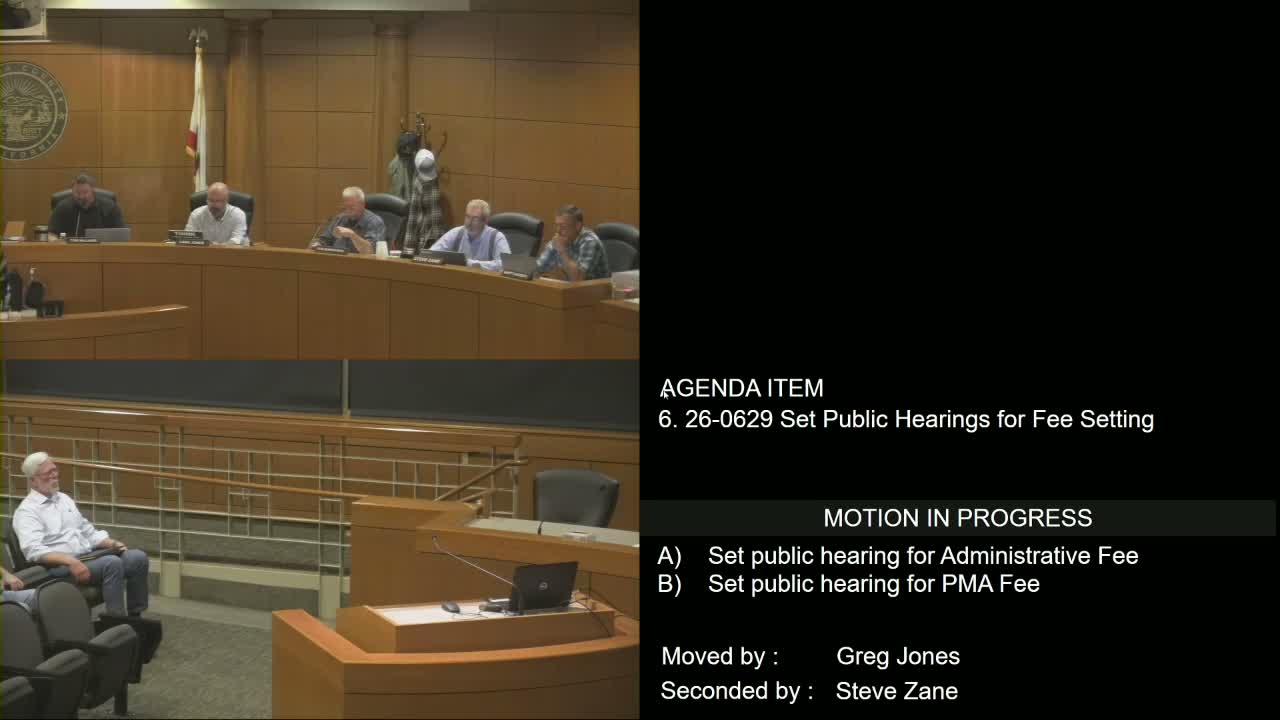
The Tehama County Flood Control and Water Conservation District board voted April 23 to accept a consultant-prepared fee study and to move forward with public hearings on proposed groundwater fees. The board approved staff’s recommendation to use a volumetric (per acre-foot) approach for the GSA administrative fee and for PMA (program management actions) fees, and it directed staff to mail protest notices ahead of public hearings set for June 18 at 9:00 a.m. (administrative fee) and 11:00 a.m. (PMA fee).
The action implements the Groundwater Commission’s suggested edits to the study, most notably a recommended $1,000,000 five‑year cap on PMA budgets. Consultant presentations to the board laid out two alternatives for PMA funding; the commission recommended the lower funding ceiling and staff included that recommendation in the version the board approved to go to public notice. Justin Jensen, deputy director, told the board the mailers and protest process must proceed on a tight timeline so the assessor’s roll can be prepared if fees are adopted.
The recommended fee package shown to the board combined a GSA operations recommendation of roughly $2.70 per acre-foot and a recommended PMA rate of $2.00 per acre-foot for the initial year(s), plus an administrative billing charge per parcel (estimated in the draft at about $1.99). Consultants and staff repeatedly described those numbers as recommendations and placeholders for notice; final fee levels will be set at the fee‑setting hearing after the public-protest process is completed.
Public commenters and several board members pressed for clearer accounting and for guarantees that PMA revenues collected in one subbasin will be budgeted and spent in that subbasin. Several speakers, including Farm Bureau representatives and individual landowners, warned that complex volumetric rules will produce administrative burdens and urged a simple per‑parcel approach for predictability. Counsel and staff said the district already separates program accounting by cost codes and that PMA funds will be tracked by subbasin in the annual budgeting process.
The motion to accept the fee study as amended by the Groundwater Commission (volumetric approach for both fees, and a $1,000,000 PMA cap) was moved by Director Matt Hansen and seconded by Director Rob Burrows. The roll call passed 4–1 (Director Greg Jones opposed). The board directed staff to proceed with mailers and the protest‑ballot timeline ahead of the June 18 public hearings.
Next steps: staff will finalize the mailed notices and fee notices for each customer class, accept corrections from property owners during the notice period, and present final fee rates and the protest tally at the June hearings. If the board adopts fees at that hearing, staff will transmit the assessment roll to the county assessor for collection.