Get Full Government Meeting Transcripts, Videos, & Alerts Forever!
Get email alerts on the Land Use Housing topic
No spam. Unsubscribe anytime.
Council advances zoning change to permit residential care facilities by right; approves consent calendar including Fire Station contract
Summary
After a lengthy debate over definitions, parking minimums and downtown impacts, Petaluma’s council voted to introduce a zoning‑text amendment to streamline residential care facilities (RCFs) and approved the consent calendar (items 1–8), including awarding a Fire Station No. 1 construction contract amid questions about contingency funding.
The Petaluma City Council on Jan. 26 approved an ordinance introduction to amend zoning rules to implement the housing element program that streamlines permitting for residential care facilities and establishes parking standards, and it also approved its consent calendar — including awarding the Fire Station No. 1 construction contract to Mid State Construction.
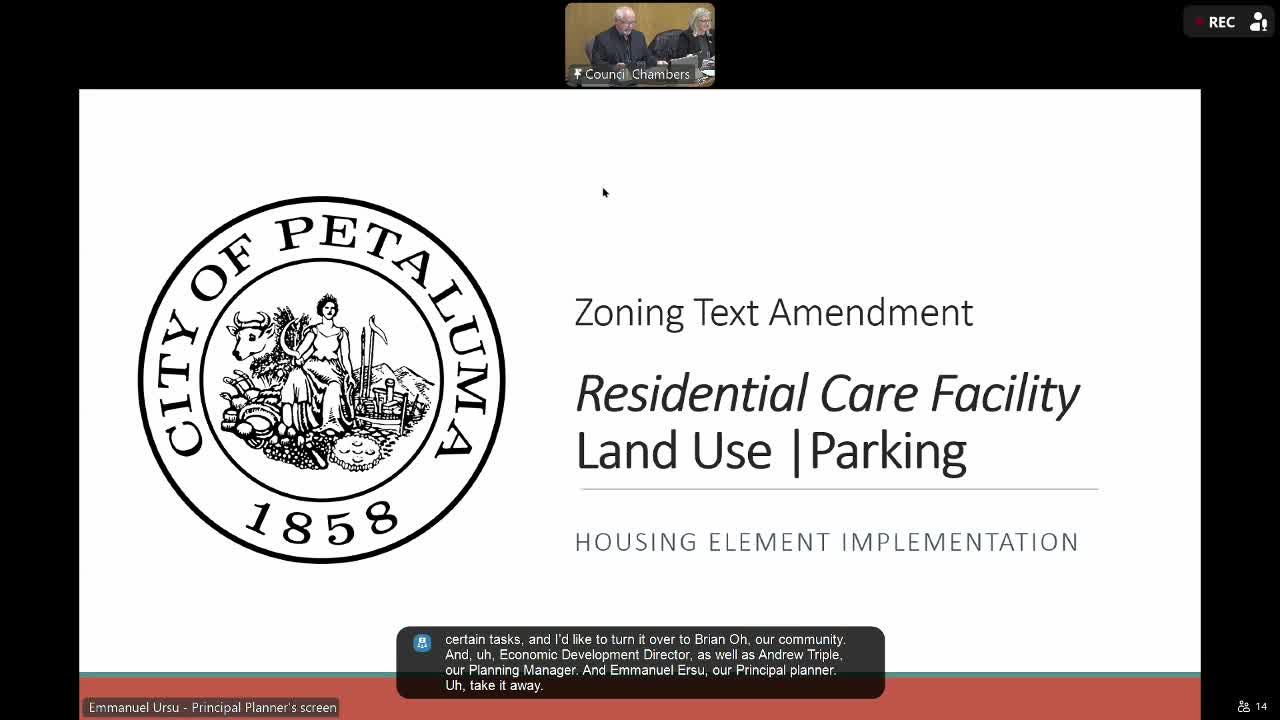
Principal Planner Emmanuel Ursu told the council the ordinance collapses multiple state licensing categories into a single local definition of “residential care facility” for zoning purposes, allows such facilities by right in residential zones and in many mixed‑use or commercial zones (subject to site plan and architectural review in designated frontage areas), and adds specific parking requirements. “This ordinance would permit by rights residential care facilities in all residential zones, mixed use zones and in commercial districts,” Ursu said.
Council discussion focused on several topics: where the line falls between RCFs and senior apartments or skilled nursing (staff said the distinction hinges on whether a state license is required), minimum parking levels and how the new rules would affect downtown and neighborhood parking, whether the change uses state streamlining in ways that restrict local controls, and how these projects would count toward RHNA and linkage-fee obligations. Staff said inclusionary housing requirements cannot be applied to RCFs because of state preemption, but commercial linkage fees may apply to elements of the facilities that are not dwelling units.
Vice Mayor DeCarly voted no; the ordinance change passed on a roll-call vote. “I don't find the sudden closure [referring to earlier subject matter] acceptable ... this makes us look bad as a city,” DeCarly said during earlier comments; on the zoning item she expressed concerns about minimum parking and neighborhood impacts but staff and other council members emphasized the need to remove development barriers to increase supply for an aging population.
On the consent calendar, staff answered council questions about a CIP item (public-safety building / fire station) where contingency and administrative costs rose substantially after plans moved from preliminary estimates to detailed design; staff and the CIP project manager explained increases reflect asbestos/lead abatement risks and unknown structural costs in a 100‑year building and said Measure H revenues are identified to cover initial contingency needs. Public comment included Mid State Construction representatives who defended their company record and urged award.
Why it matters: the ordinance aims to speed construction of housing for older adults and other groups served by licensed residential care, which local officials say is an acute need given demographic trends. Opponents and residents urged careful neighborhood planning and higher parking standards to avoid spillover impacts.
What’s next: the ordinance moves into effect according to the city’s public‑notice and adoption schedule; staff will apply the new parking and SPAR standards to future projects and continue outreach at the project stage.