Get Full Government Meeting Transcripts, Videos, & Alerts Forever!
Get email alerts on the Transit Service Modifications topic
No spam. Unsubscribe anytime.
Petaluma transit panel weighs cutting LumaGo, Sunday and late‑evening service to close FY27 gap
Summary
At a Jan. 20 workshop, Petaluma Transit staff outlined options to close an estimated FY27 shortfall — including ending the LumaGo on‑demand service, eliminating Sunday service and trimming service after 7 p.m. — and asked the Transit Advisory Committee and public for guidance on priorities, grant scenarios and partnerships.
Petaluma Transit staff told the Transit Advisory Committee on Jan. 20 that a package of route adjustments and service reductions could close a projected FY27 operating shortfall and asked the committee to advise which options to prioritize.
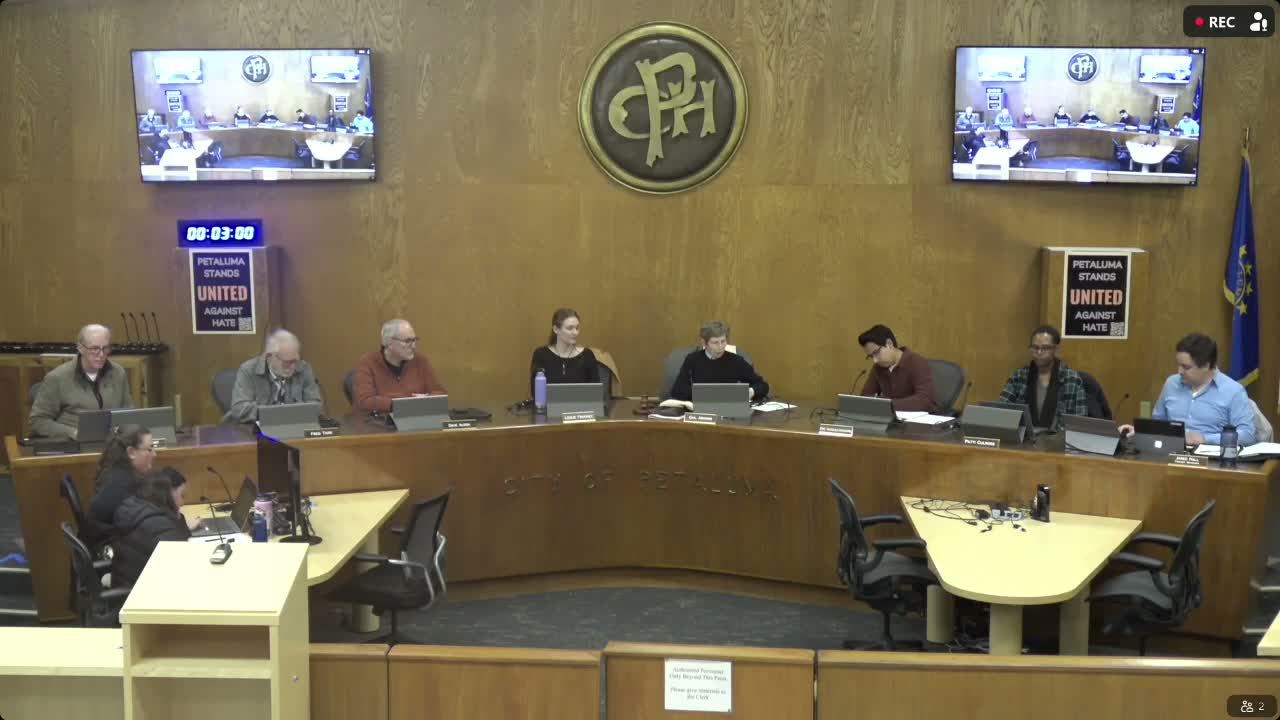
At a workshop in Council Chambers, transit staff presented multi‑year ridership trends and route‑level “cards” that show boardings, productivity and cost. Jared, the presenting transit staffer, said the LumaGo on‑demand service — launched in October 2024 — has met performance goals but costs about $420,000 a year. “This route is costing $420,000 per year,” he said, adding that the service has a tentative SAFA grant award that would provide roughly $150,000 if finalized.
Staff outlined three LumaGo scenarios: run the service for a full year and absorb an estimated roughly $280,000 shortfall; operate only through the grant period with a roughly $100,000 shortfall; or suspend the service if additional grants cannot be secured. Staff recommended terminating LumaGo under the conservative budgeting scenario unless additional funding is found.
The presentation also flagged route‑level and schedule changes: keeping MTIS‑funded 15‑minute headways on Routes 2 and 11 while grants last, eliminating a small number of peak trips on Route 24 (estimated annual savings ~$42,000), discontinuing Sunday fixed‑route service (routes 2, 11 and 33 plus associated paratransit) to save about $140,000 a year, and cutting service after 7 p.m. on several routes to save about $65,000 a year. Staff said implementing the full set of proposed items could yield up to $1,074,000 in FY27 savings under conservative assumptions and move the FY27 deficit into a modest surplus.
Committee members pressed staff on the arithmetic behind the numbers, asking whether route‑level savings are modeled on driver hours only or include fully allocated fixed costs. Staff said the slides presented a conservative calculation based on driver hours and that some fixed costs (software, capital) would not fall with service reductions. Staff also explained that cutting fixed routes can generate secondary savings by lowering paratransit costs when complementary fixed‑route service is reduced.
Public commenters urged preserving critical services and exploring partnerships. Katie McComb, a student at Santa Rosa Junior College representing the Transit Access Club, asked the committee to consider student schedules and evening access, saying students rely on transit for late classes. Anna Cordova of the Family Resource Center said families benefit from LumaGo and urged maintaining the service if possible. Ben Peters of the city’s Climate Action Commission urged staff to pursue electrification funding (LCFS) and to pursue sponsorships or employer partnerships — specifically suggesting Kaiser be approached to help fund Route 24, which serves a Kaiser facility.
Committee members debated how much to cut this year versus in later years. Several members urged pursuing partnership and sponsorship opportunities (ads, employer support), maximizing grant pursuit and analyzing potential overlaps with Sonoma County Transit before eliminating routes. One commissioner recommended adopting the current proposed reductions as a first step and then measuring secondary savings from those cuts before deciding on deeper cuts in later years.
Staff said the TAC’s input will be incorporated into a recommended package for the committee’s Feb. 17 meeting; staff plans to forward a recommendation to the City Council for consideration on April 6 (with a backup date of May 4) and implement approved changes on July 5, 2026.
The committee also approved the Dec. 16 meeting minutes as presented (consensus; no roll‑call vote recorded) and adjourned at 8:25 p.m.