Get Full Government Meeting Transcripts, Videos, & Alerts Forever!
Get email alerts on the Streets topic
No spam. Unsubscribe anytime.
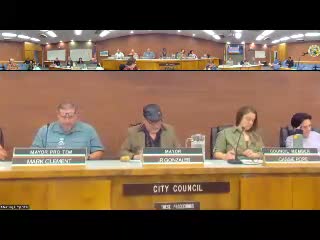
Red Bluff council weighs contingency street plan if Measure S fails; staff pledges clearer public plan
Summary
Facing tight funds, Public Works Director Scott Miller told the council the city can build about $900,000 worth of street projects a year and detailed prioritized work on South Jackson and the First & Franklin residential complex; councilmembers pressed for a public-facing plan and interim patching options.
Public Works Director Scott Miller told the Red Bluff City Council on March 3 that, if the ballot measure known as Measure S does not pass, the city will pursue a limited set of street projects and continue seeking grants, but resources will remain constrained. "We generally get right around $900,000 a year that can go towards streets improvements," Miller said, clarifying that much of the city's street funding goes to staff, operations and equipment as well as project construction.
The discussion centered on which projects the city would prioritize and how to explain the choices to residents. Miller identified South Jackson Street (95% design complete), the First & Franklin Street residential complex (about 60% complete), and a Walnut Street pedestrian-and-bike grant-funded project as priorities. He told council that some residential streets are in such poor condition that full reconstruction is required and that work on curb, gutter and sidewalks can more than double project costs.
Council members pressed staff on options for interim repairs and better communication with the public. "People would appreciate a simple plan: here are the top streets, here's an estimated timeframe, and here's what we can do in the interim," said Council member (speaker) Chris, who repeatedly asked that staff produce an accessible summary for residents. Miller and staff agreed to compile a summary of shovel-ready projects and post it on the city's webpage and social platforms; staff also said they would return to council with a clearer plan and timelines.
Council members and staff also discussed how grant restrictions limit where some funds can be spent. Miller noted a $3 million grant for pedestrian and bike-path improvements on Walnut Street that cannot be used for vehicle improvements, and he said the city has repeatedly pursued grants for South Jackson with limited success.
The council discussed the city's pavement condition-index (PCI) and possible repair strategies ranging from chip sealing to full-depth reclamation. Miller said many residential streets in older neighborhoods fall into the "failed" category and require major rehabilitation; doing so triggers additional requirements including ADA-compliant sidewalks and ramps.
Miller and Robin Kaufman, a staff member working on water and other capital projects, said the city has shovel-ready designs for some segments and can move quickly for grant applications or to go to bid when funding becomes available. "We can find a way to put a summary on our street section of our web page," Kaufman said, pointing to a plan to publish which projects are currently in design and their status.
The council did not adopt a new funding plan at the meeting. Instead, members directed staff to prepare and present a clear, public-facing summary of street priorities, potential interim repair options for residential areas, and the funding constraints that affect timing and scope. Staff said that, with direction, they would return to council with details to support communication with residents.
What happens next: staff will prepare the project summary and a return agenda item with recommendations on prioritization and potential interim treatments for residential streets.