Get Full Government Meeting Transcripts, Videos, & Alerts Forever!
Get email alerts on the Transit Budget Service Changes topic
No spam. Unsubscribe anytime.
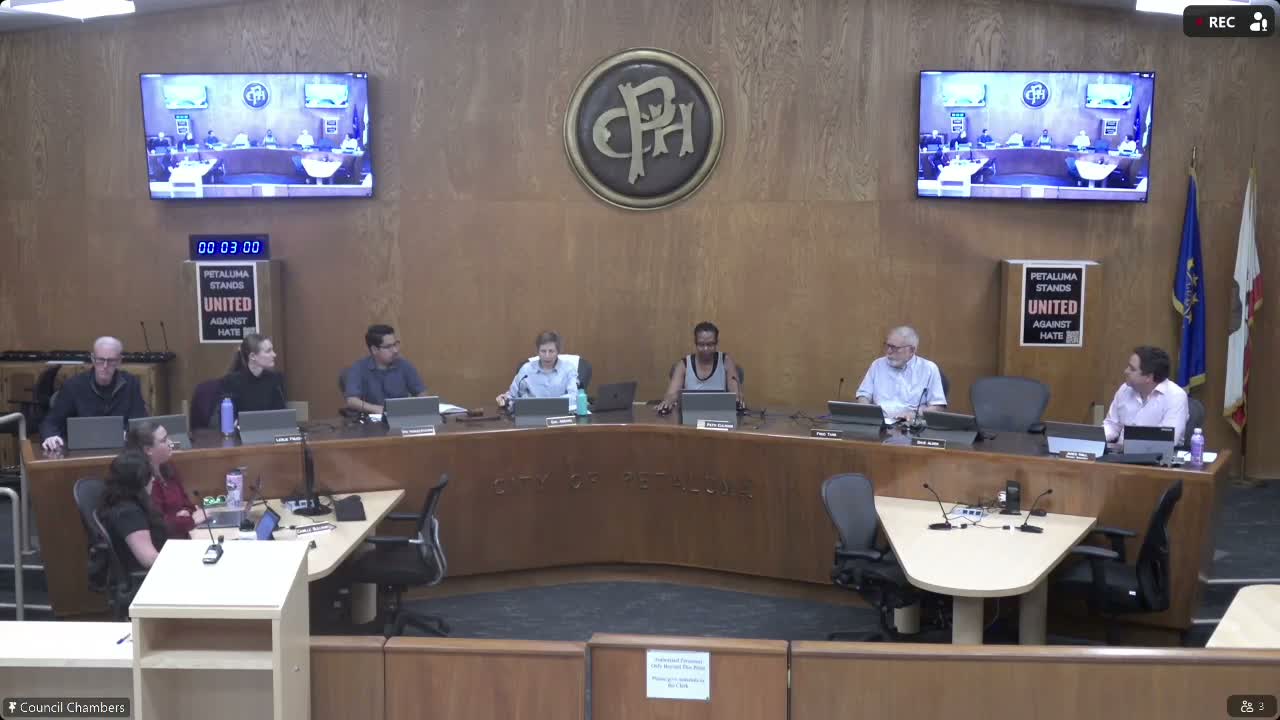
Petaluma transit panel backs conditional 2‑year budget plan, urges council to fund priorities if county funding isn’t secured
Summary
The Petaluma Transit Advisory Committee recommended a staff-backed 2‑year plan of service changes and cost measures—contingent on recovering an estimated $260,000 a year from a county funding arrangement—and asked City Council to consider targeted general-fund support for late-night service and a Route 24 Saturday pilot.
The Petaluma Transit Advisory Committee voted March 17 to recommend staff’s “2‑year” package of service reductions and complementary funding steps to City Council — but did so conditionally: if the city can withdraw from a county coordinated funding arrangement and recover an estimated $260,000 per year, the committee endorsed the 2‑year approach; if not, it said the more severe 3‑year plan should be presented instead.
Staff presented the recommendation as a mix of route adjustments, temporary staffing pauses and one-time grant offsets. Presenter Jared said staff is “looking at making several changes to service,” including converting Route 10 from an all‑day route to a limited school tripper, shortening evening service, and eliminating Sunday service under the deepest cuts. The committee heard staff’s estimate that a 12‑month Saturday pilot for a modified Route 24 serving Lakeville to Scholenberger Park would cost about $15,000 a year.
Why it matters: committee members repeatedly framed the discussion as an equity question. Public commenter Annie Nickel, who identified herself as a board member of local nonprofit COTS, told the committee: “Who are you serving? Who is this gonna hurt?” She urged staff to account for riders who work nights, use shelters or lack other options.
Staff emphasized recent one‑time revenue changes that improved the budget outlook since earlier presentations. Camille, who reviewed the spreadsheets, said the committee’s revenue picture had changed after the city accepted grants such as the Clean California Communities and Employment Pathways (CCEP) award and a Safe Access for All (SAFA) grant and after expanded transit advertising plans. Staff also said they are pursuing a repurposing of TDA funds from Sonoma County Transit that would shift about $260,000 annually to the city; staff described that arrangement as not yet finalized and noted a letter of intent was expected to be sent to county partners.
What the proposal would change: under the staff recommendation (the option the committee endorsed conditionally), the city would: - Convert Route 10 to a limited tripper to retain school connections while removing low‑ridership all‑day service; staff said ridership on the Route 10 corridor has dropped to “less than 2 or 3 people a day” on some legs. - End late‑night service earlier in the evening (the staff presentation framed reductions in the last service hour as a way to reduce low‑ridership costs). - Cancel Sunday service only under the more severe 3‑year scenario; the 2‑year plan removes Sunday service only in the deeper package. - Cancel the LumiGo late‑night contract in FY27 unless one‑time grants continue to support it; staff said some grants will allow limited continuation for the coming year. - Pilot a Saturday Route 24 service — staff estimated this pilot at roughly $15,000 per year — to serve transit‑dependent neighborhoods along Lakeville.
Staff also said the city had paused hiring for drivers earlier and temporarily paused two planned city staff positions (a senior planner and an administrative tech) to avoid layoffs while the service mix is revised.
Committee action and next steps: the panel approved a motion directing staff to present the conditional recommendation to the City Council at an April workshop and to flag the committee’s top priorities for possible general‑fund support. The motion — moved from the dais and seconded — carried in a roll‑call vote of committee members (motion recorded as passing). Chair Abrams and staff said the council workshop is for discussion and guidance, not final action; any formal budget decisions would be folded into the FY27 budget process.
What remains unresolved: staff told members the $260,000 per‑year figure tied to Sonoma County/TDA repurposing is not yet a binding agreement. A vote by the Sonoma county board on the coordinated claim is expected in April; staff said the city would send a letter of intent in advance and that political pushback is a likely risk if the city formally withdraws from the prior informal arrangement.
Committee members repeatedly asked staff for clearer spreadsheets; several asked that staff post the underlying Excel model so members can review line‑by‑line assumptions before council. Staff acknowledged a prior accounting presentation error and said they had revised the sheet and could post the corrected version.
The committee asked staff to forward two top priorities — preserving later weekday service and adding the Route 24 Saturday pilot — as recommended items for City Council consideration if the council elects to allocate general‑fund support. Jared said staff would include the committee’s feedback in the April council workshop packet. The committee adjourned after hearing staff’s transit‑manager update, which noted completion of the transit electrification capital project (ten chargers active and the first four electric buses entering full‑time service).