Get Full Government Meeting Transcripts, Videos, & Alerts Forever!
Get email alerts on the Immigration topic
No spam. Unsubscribe anytime.
Residents urge Moorpark to form immigration stakeholders group as sheriff clarifies limits
Summary
Multiple residents urged Moorpark leaders to create a community immigration services stakeholders group to support residents amid increased ICE activity; Sheriff Jim Freyhoff said local law enforcement cannot perform federal immigration enforcement but will respond to 911 calls; city staff offered to continue and expand ad hoc coordination.
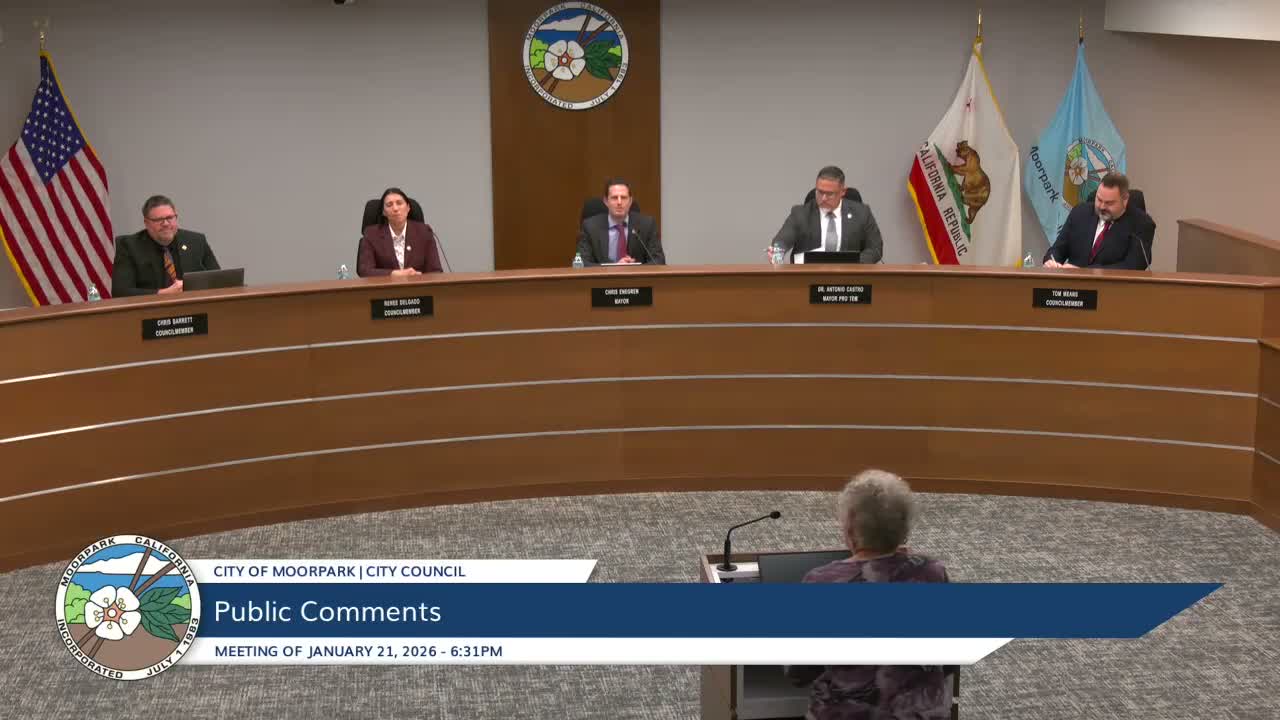
Multiple Moorpark residents used the public-comment period at the Jan. 21 City Council meeting to press elected officials to create a local immigration services stakeholders group modeled on Oxnard’s effort.
Several speakers described fear in the community after widely shared videos of aggressive federal immigration enforcement in nearby jurisdictions. Pam Orin said she has received “telephone calls, text messages” from friends who are “terrorized” by increased ICE presence and urged the council not to allow similar tactics in Moorpark. Paul Carganilla, a Moorpark resident who works for the City of Oxnard as a community affairs manager, described Oxnard’s biweekly stakeholder group — which includes elected officials, police, school representatives and rapid-response groups — as a nonpolitical forum that shares accurate information and coordinates community supports. He urged Moorpark to form a similar group so residents “know they are seen, you are valued, and your city cares about your safety and dignity.”
Other commenters asked for concrete local measures. One speaker, Lynn, thanked the council for past workshops and called for rapid-response preparations to protect daycares, schools and businesses. Christina Delatorre and Shaylee Trevetti read names of people the speakers said died in ICE custody to underscore the urgency and asked the council to permit a moment of silence.
Sheriff Jim Freyhoff addressed the council near the end of public comment and described the legal limits on local enforcement. “The state of California is in fact a sanctuary state,” he said, adding that local law-enforcement agencies do not carry out federal immigration enforcement. The sheriff said his office may communicate with federal authorities only for people in custody who are convicted or charged with serious or violent crimes, listing examples such as child molestation and murder. He also said that federal partners previously notified local agencies of planned operations but that those notifications stopped in mid-December; the sheriff said his office has observed federal activity in the community through social media since then.
City Manager (staff) summarized prior City actions and offered continued coordination. The manager told councilmembers the city has hosted an immigration-resources workshop, posted resources on the city website, partnered with community organizations to support businesses affected by enforcement actions and maintained ongoing informal meetings with residents since June. City staff offered to continue those ad hoc meetings and to expand them if the council desires, noting that a formal ad hoc committee may include up to two council members to remain compliant with the Brown Act.
Council reaction was supportive of further coordination. Several councilmembers expressed support for the concept of a stakeholder or advisory forum and asked staff to continue outreach; staff said they would invite Police Chief Odenath and offered to include up to two council members at meetings. The council did not take a formal vote on establishing a standing committee during the meeting but directed staff to continue convening and to report back if the council wants a formal agenda item.
The council’s near-term actions coming out of the meeting were: continued staff-led coordination with residents and community organizations, an offer to expand the informal stakeholder meetings, and an option to create a staffed ad hoc group that could include up to two council members.