Get Full Government Meeting Transcripts, Videos, & Alerts Forever!
Get email alerts on the Code Enforcement topic
No spam. Unsubscribe anytime.
Board places dozens of $3,000 liens after lengthy code-enforcement hearings
Summary
After a day-long series of environmental-health hearings, the board approved multiple $3,000 nuisance liens for properties with inoperable vehicles, trash, substandard or unpermitted structures and occupied RVs; staff allowed some cases to be tabled for remediation or withdrawn when fines were paid.
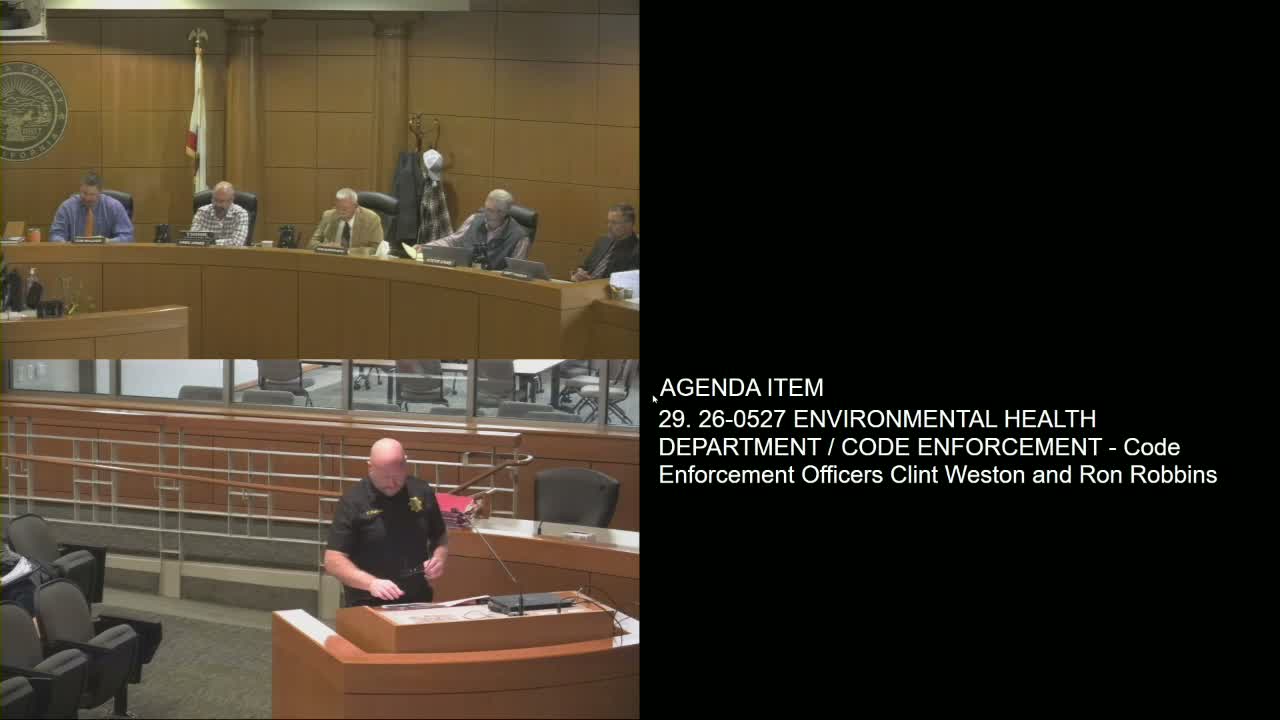
The Tehama County Board of Supervisors spent a substantial portion of its April 21 meeting on environmental health code-enforcement hearings and ordered liens or other remedies in many cases.
Code enforcement staff (Ron Robbins and others) presented more than a dozen cases alleging public-nuisance conditions: junk and debris, inoperable vehicles, substandard travel trailers and unpermitted structures being used for human occupancy. For the vast majority of cases the board adopted resolutions to place administrative-penalty liens (commonly $3,000) on affected parcels for noncompliance; the board used the authority under Tama County Code chapter 10.16 and cited Government Code §53069.4 during the hearings.
Several owners appeared and either accepted the findings or asked for time and assistance. In one case the property owner asked for leniency and guidance; the board agreed to table a matter for 90 days to allow the owner to pursue eviction and cleanup steps with code enforcement and sheriff's office assistance. In another case a hearing participant who said he has a hearing impairment asked for a face-to-face walkthrough; the board instructed staff to provide a punch list of required corrections and to work with the resident on accessible communication. In multiple cases staff noted that cleanup or permit purchases could allow owners to seek compromise and removal or reduction of assessed liens.
Supervisor Walker emphasized that a lien is only an enforcement tool: once the violation is abated and any fees paid or compromised, the lien can be removed. Code enforcement staff repeatedly noted that invoices and liens are a last resort after repeated notices and community complaints.
Ending: The board approved the liens and directed staff to coordinate follow-up inspections, compromise requests and any necessary referrals to the building department for permit work or demolition permits when structures had to be removed.