Get Full Government Meeting Transcripts, Videos, & Alerts Forever!
Get email alerts on the Telecom Facilities topic
No spam. Unsubscribe anytime.
County planner briefs commission on cell‑tower technology, FCC 'shot clock' and local limits
Summary
A Tehama County planner explained radio‑frequency basics, coverage mapping, local code constraints (including a five‑mile spacing rule and stealth requirements), and the FCC shot clock (60–150 days, 150 for standalone towers), warning the commission that if it does not act within the shot clock an application can be deemed approved.
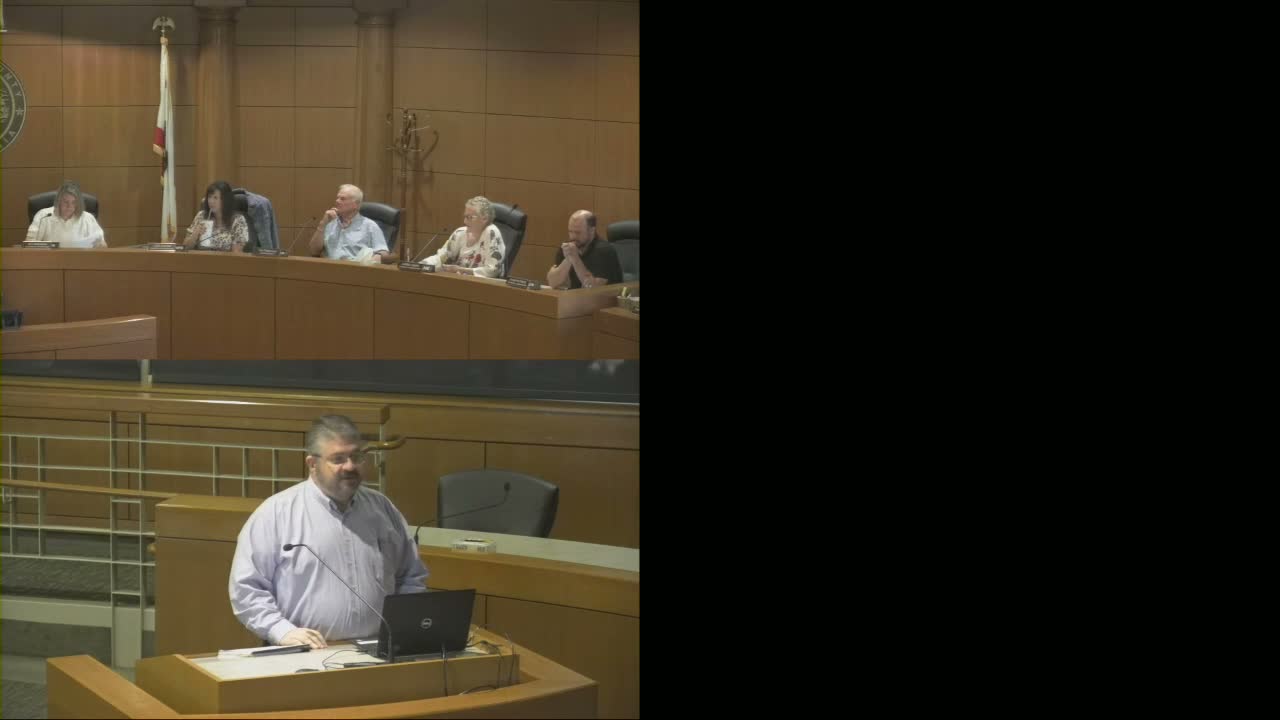
Greg Rediker, a planner with Tehama County, led a study session on March 19 to prepare commissioners to review multiple communications‑facility use permits.
Rediker explained radio‑frequency bands, coverage maps, and how higher frequencies carry more data but over shorter distances. He emphasized federal preemption in safety standards and described key constraints imposed by the Telecommunications Act of 1996 and FCC implementing rules. “If the local jurisdiction does not act in time, the application is deemed approved,” Rediker said, summing up the practical consequence of the FCC shot clock.
He walked commissioners through local code Chapter 17.71 (Communications Facilities), noting Tehama County’s requirements that applicants provide stealth design options (for example, monopine disguises) and a local spacing policy that generally prevents new towers within five miles of an existing tower unless the Commission finds aesthetic impacts negligible or the facility is necessary to provide service. Rediker also noted the county currently allows towers up to 199 feet without triggering FAA lighting/striping requirements.
Rediker reviewed the shot‑clock timeframes in the staff packet (60–150 days depending on facility type), the limited circumstances when the clock can be tolled by mutual agreement, and the administrative consequence of failing to act in time: the application can be deemed approved and triggers a short time window for judicial challenge. He cited a past instance (identified as a Begum project) where the county exceeded the 150‑day window and the application was considered deemed approved.
Commissioners asked practical questions about when the shot clock starts (at date of application), how the county’s 30‑day completeness review affects tolling (it does not stop the shot clock), and whether county input or public comment affects decisions (it does; applicants must still meet local findings). Rediker said staff had seven communication‑facility applications in process and expected to bring five or six to the Commission in April and May for decision or continued review.