Get Full Government Meeting Transcripts, Videos, & Alerts Forever!
Get email alerts on the Health Policy topic
No spam. Unsubscribe anytime.
Tehama County officials warn HR 1 could shift millions in costs to county services
Summary
County health and social services leaders told the Board of Supervisors that HR 1is already reducing federal match and will raise county administrative and benefit-cost sharing, increasing workload for eligibility staff and likely reducing CalFresh and Medi-Cal coverage for thousands of residents.
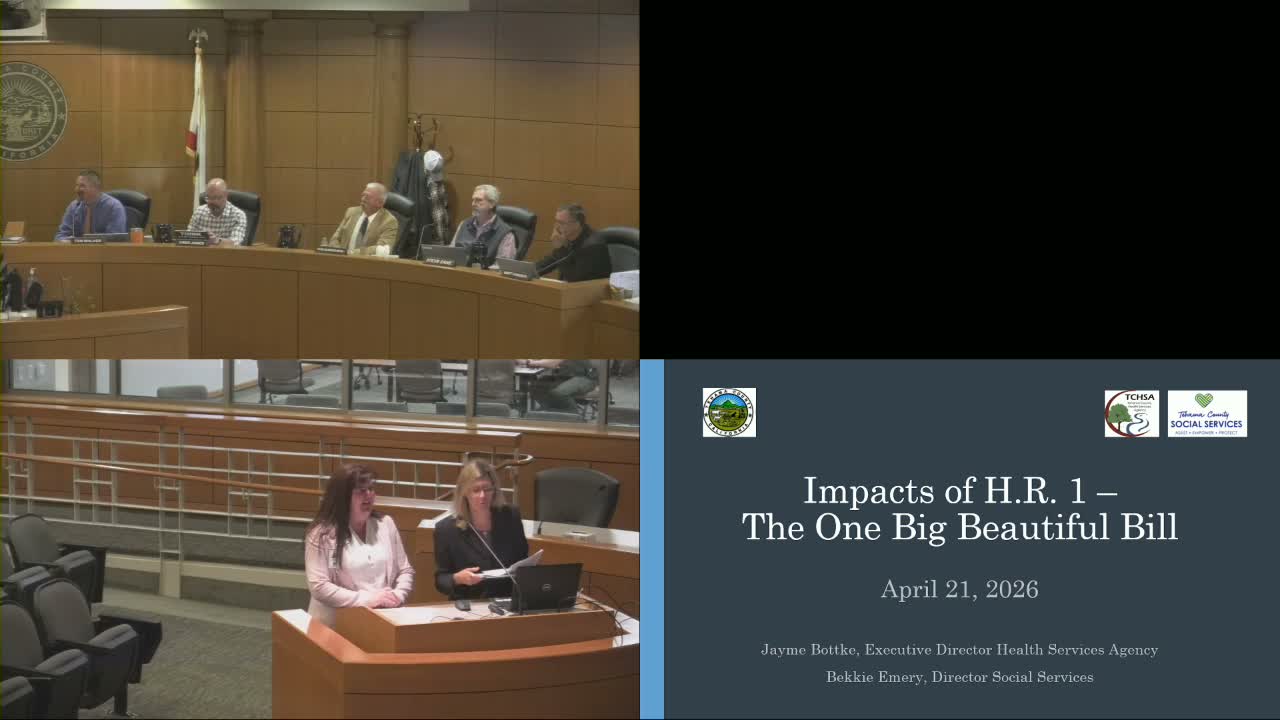
Jamie Botke, executive director of Tehama County's Health Services Agency, and Becky Emery, director of Social Services, told the Board of Supervisors on April 21 that HR 1is producing immediate and projected costs for the county.
Botke and Emery said the law's provider-tax changes and other provisions have already reduced federal matching funds and will shift new administrative and benefit costs to counties. "Starting in October, we're looking at about a 7.5% cost-share increase with no offsetting funding," Emery said, estimating roughly $400,000 in county administrative exposure to Social Services under current assumptions.
That change is compounded by implementation steps the presenters said will increase program churn and staff workload. Emery said the state will move Medi-Cal to six-month redeterminations in January 2027, effectively doubling some eligibility work. "Our eligibility staff are already short-staffed and it takes approximately two years to train new staff," she said.
The presenters outlined local population and program counts to show scale: Tehama County serves roughly 24,000 households and 65,000 people; about 13,600 households and 30,000 individuals currently receive Medi-Cal through the county system, and roughly 6,700 households (about 15,600 people) receive CalFresh benefits processed by the county. Botke and Emery said state-level changes could mean a 15% decline in CalFresh recipients statewide, which they estimated would equal about 2,400 fewer people receiving benefits in Tehama County and about $4 million less CalFresh purchasing power flowing into the local economy annually.
Board members pressed presenters on mitigation strategies. Botke and Emery described planned local actions: cross-training staff as "assisters" to work alongside clients, piloting technology and verification systems to reduce manual checks, pursuing grants such as rural transformation funds, and continuing advocacy through statewide county groups (CBHDA, CSAC, CWDA) to secure offset funding. "We're working on multiple systems to verify work and medical information, and partnering with hospitals to keep people covered where possible," Botke said.
Members of the public and at least one caller urged the board to be proactive on budgeting and to press the state for support. The board discussed letters of support it had already signed for county advocacy efforts.
Next steps: county staff said they will continue outreach, pursue grant opportunities and follow state guidance on waivers. Supervisors asked staff to return with ideas for budget contingency and to monitor the CMSP governing-board hearings in May for changes to indigent-care eligibility.
Ending: The board did not take any immediate policy vote on HR 1 during the April 21 meeting; staff will report back as implementation items and funding requests evolve.