Get Full Government Meeting Transcripts, Videos, & Alerts Forever!
Get email alerts on the Solid Waste topic
No spam. Unsubscribe anytime.
Committee declines to recommend on incinerator closure; long‑haul trucking and higher service charges outlined
Summary
After an extended presentation of solid‑waste options, the Transportation and Environment Committee voted not to issue a committee recommendation on the county Resource Recovery Facility (incinerator) closure proposal and will send the matter to full council. Staff outlined the executive’s six‑month closure assumption, estimated long‑haul costs, decommissioning figures, and projected service‑charge increases.
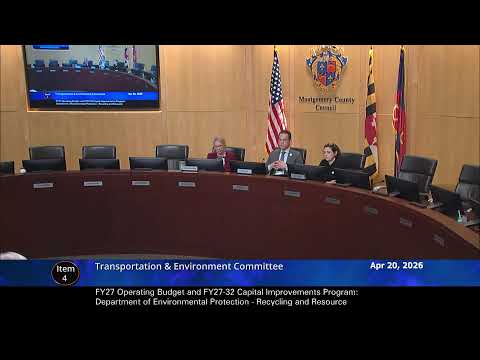
Montgomery County’s Transportation and Environment Committee on April 20 did not make a committee recommendation on whether to close the county Resource Recovery Facility (RRF), instead forwarding the decision to full council after extended questions about cost, air emissions and regional impacts.
Staff presented two primary budget scenarios in the FY27 packet: the county executive’s recommendation (operate the RRF for six months in FY27 and then transition to long‑haul trucking for the remainder of the year) and a ‘‘current operations’’ scenario (a full‑year operation of the RRF). Staff said the executive‑scenario adds a large half‑year long‑haul contract cost (presented as a roughly $43.9 million line item for the half‑year long‑haul) and concurrently removes some short‑term capital spending that otherwise would have funded investments negotiated with the operator to extend operations through 2031.
Director Jennifer Macedonia and recycling staff summarized environmental, health and financial trade‑offs. Committee members raised recent reports about emissions as part of the policy rationale: one committee member said reports showed emissions of dioxins and furans that informed their view that closure should be pursued. The committee acknowledged the issue is complex and involves trade‑offs for cost, environmental justice and regional hauling/traffic impacts.
Staff discussed operational specifics for a closure scenario: a signed long‑haul contract would trigger a six‑month notification to the operator; the county has an RFP under evaluation but had not finalized a vendor pending council direction. Staff estimated a net additional truck count of roughly 40 trucks per day at nearby transfer routes under the long‑haul approach (after reductions from shifting C&D disposal to private recyclers), and noted fuel‑price indexing clauses and other contract features may affect long‑term pricing.
On decommissioning and capital, staff described a total decommissioning estimate of about $7.2 million (with roughly half budgeted in FY27 depending on timing) and noted previously negotiated short‑term capital investments totaling tens of millions (the packet cited multi‑year capital on the order of $60–70 million to keep the RRF operating through 2031). Staff explained that delaying a decision raises the likelihood of incurring more short‑term capital or restarting procurement.
Fiscal impacts to ratepayers: staff presented proposed FY27 service‑charge tables; under the executive’s recommended approach single‑family household charges would increase compared with FY26 (packet example cited an approximate $14.33 annual increase under the executive recommendation, with larger increases under a full current‑operations scenario). Staff emphasized that solid‑waste and water‑quality charges are placed on the June tax bill and must be set in time to appear there.
Motion and outcome: following debate, a committee member moved that the committee not issue a recommendation on the RRF/incinerator item; the motion was seconded and carried. The committee therefore deferred the final decision to full council, and other budget and non‑RRF items in the packet were treated as recommended by staff for the committee’s part of the process.
What’s next: the matter will be scheduled for full council consideration; staff will return requested clarifications on funding shifts, exact resident impacts, and any technical changes to potential long‑haul contracts before council action.