Get Full Government Meeting Transcripts, Videos, & Alerts Forever!
Get email alerts on the School Referendum topic
No spam. Unsubscribe anytime.
Haddonfield School District outlines referendum to fix accessibility, add classrooms and renovate auditoriums; vote set for Dec. 10
Summary
District presenters at a town-hall described a comprehensive facilities referendum to address accessibility shortfalls, classroom capacity and outdated auditoriums and athletic facilities; officials said design work would begin after a successful Dec. 10 special election and emphasized sequencing to limit in‑year disruption. (Numbers for total cost cited in the meeting transcript were reported inconsistently; see clarifying details.)
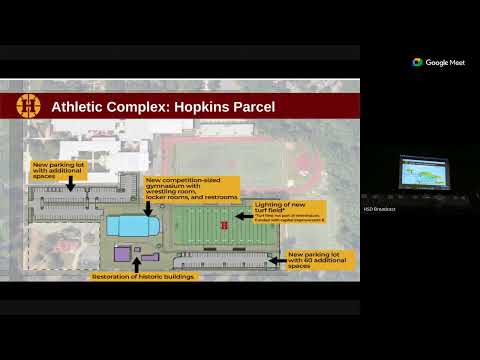
Haddonfield School District officials presented a multi-school facilities referendum at a town-hall, outlining planned upgrades intended to address accessibility, classroom capacity, auditorium and stage systems, athletic fields and parking, and restorations of three historic buildings. The district said the measure will go to voters in a Dec. 10 special election and that mail ballots and regular polling will be used.
District presenters told attendees the proposal targets six priority areas: accessibility, classroom space, athletics and auditoriums, early‑childhood and growing‑child education, specialized learning spaces and media centers. "Accessibility we see this is mission critical," a district presenter said, explaining that several buildings lack elevators or direct accessible routes and sometimes require moving classrooms to the first floor to accommodate students with mobility needs.
Why it matters: officials said aging systems and constrained space are affecting instruction and safety — broken auditorium seating, outdated stage lighting, limited nurse-room capacity at some schools, and classroom configurations that leave some grade levels at or above target sizes. The presenters described enrollment projections through 2028–29 and said those forecasts, combined with ongoing development, justify additional classroom capacity.
Scope and sequencing: Architects and construction staff described the planned work in some detail. An architect said auditorium work would include new seating and ADA-accessible seating, updated stage lighting and rigging, mechanical and electrical upgrades, and backstage/dressing‑room improvements while preserving historic character. The district said it intends to maximize summer construction for noninvasive work and sequence larger additions to minimize curriculum disruption; officials identified early projects likely to include roofing replacements, ADA upgrades and playground work.
Funding and trade‑offs: presenters framed the referendum as a pared‑down package after prior analysis of larger needs and said state reimbursement formulas affect eligible costs for new construction versus renovation. Meeting remarks referenced tax‑impact examples and various dollar figures, but reporting of the total package amount in the transcript was inconsistent; district staff said they reduced the original scope to what the community could sustain and that some items depend on state funding eligibility.
Public questions and concerns: residents pressed officials on sequencing, the consequences if the referendum fails, and the rationale for some items (for example, a standalone gym and increased middle‑school auditorium seating). The district said a failed vote would require revisiting priorities, using capital reserves where feasible and cutting or delaying work. A presenter described how the middle‑school auditorium could expand seating (the transcript records a claim that seating would increase from 413 to roughly 690 seats).
Next steps: the business administrator confirmed the Dec. 10 special election date and said the district will continue outreach, including printed materials for residents who do not use the internet, small‑group meetings and mailed information. If voters approve the referendum, design work would begin promptly and some construction could start the following summer.
The town‑hall closed with staff encouraging further questions and offering contact information and follow‑up sessions ahead of the December vote.