Get Full Government Meeting Transcripts, Videos, & Alerts Forever!
Get email alerts on the Domestic Violence topic
No spam. Unsubscribe anytime.
City official says early‑intervention strategy, data upgrades central to domestic‑violence response
Summary
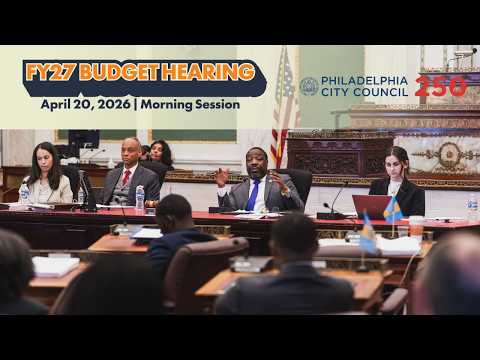
At a Committee of the Whole hearing on the FY2027 budget, Philadelphia’s Office of Domestic Violence Strategies described steps to expand early intervention, data collection and interagency training, and to modernize the domestic‑violence hotline technology to improve referrals and prevention.
Adam Teal, managing director for the city of Philadelphia, introduced members of the Managing Director’s Office and invited questions on domestic‑violence strategy.
Asus, who identified themself as director of the Office of Domestic Violence Strategies, told council the office focuses on secondary prevention: providing technical assistance to agencies that encounter domestic violence, training child welfare and behavioral‑health staff, and embedding domestic‑violence specialists in the Department of Human Services. Asus said the city’s child‑welfare system is the only one in Pennsylvania with a domestic‑violence unit that supports DHS investigators and case managers.
On data, Asus said the office compiles multiple streams: hotline call counts reported by the domestic‑violence hotline vendor, child‑welfare disclosures tracked by DHS, screening and mortality data shared by the health department, and police reports on domestic homicides. The office publishes a data fact sheet on its website summarizing city, state and national comparisons, the testimony said.
Asus described recent operational upgrades: increased funding for the domestic‑violence hotline and a technology modernization last year—the first since 2005—to improve call handling and referral tracking. They said the office uses the data to identify points for earlier intervention with health, homelessness and behavioral‑health partners.
Council members pressed on data sharing and governance. Asus said the office participates monthly in a domestic‑violence law‑enforcement committee that includes the District Attorney’s Office, sheriff’s office and community providers, and that some police homicide details come from Philadelphia Police. Asus told council the office will share its fact sheet and related data with members.
The managing director and Asus said the approach emphasizes cross‑agency prevention and earlier identification rather than shifting resources to enforcement alone. No formal budget vote occurred at the hearing; MDO agreed to provide additional numbers and documentation requested by council.