Get Full Government Meeting Transcripts, Videos, & Alerts Forever!
Get email alerts on the Wastewater topic
No spam. Unsubscribe anytime.
Public Service Committee delays vote on revised local wastewater discharge limits after EPA timing concerns
Summary
Committee delayed action on an ordinance revising local wastewater discharge limits after staff said the EPA had not yet begun its 30‑day public notice; public commenters pressed for an estimate of increased filtration costs for pollutants including benzene/BTEX.
The Cheyenne Public Service Committee on April 20 recommended postponing action on an ordinance that would revise local wastewater discharge limits to align with MPDES/WPDES permit requirements and recent EPA parameter adjustments.
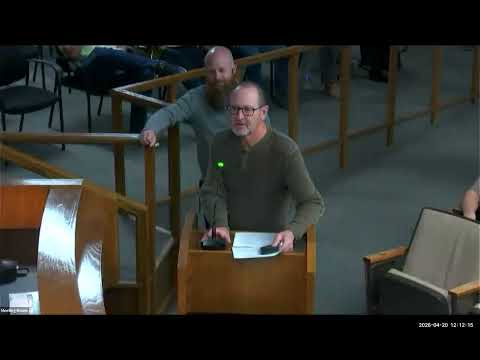
Matt Bulo, identified in the meeting as a manager in the Board of Public Utilities water/pre‑treatment area, told the committee staff had supplied an updated limits package but asked the committee to delay final approval because the U.S. Environmental Protection Agency had not yet started its 30‑day public‑notice period. "We're fearful of approving it here and then having EPA come back with comments," he said, asking for a two‑week to one‑month postponement so city and EPA processes could run without forcing the council to repeat readings later.
Public commenter Charles Miller said the engineering evaluations attached to the ordinance show higher legal maximum daily discharge limits for toxic industrial pollutants — including benzene and BTEX — and demanded the committee put on the record how much the Board of Public Utilities would have to spend annually to filter the increased concentrations. "If this body is raising the ceiling on industrial contamination, the taxpayers have a right to know the exact dollar amount of liability you are shifting onto the public," Miller said.
Tim Gbach, who said he worked with local limits development at LS Pre‑Treatment Consulting, responded that EPA had reviewed the limits package and deemed it approvable, but that EPA typically will not start the formal 30‑day public‑notice period until after at least one council reading. Brad Brooks, director at the Board of Public Utilities, told the committee EPA had not started its public‑notice advertising in this instance and that timing uncertainty was the primary cause of delay.
Committee members debated whether to adopt an amendment by substitution before or after postponing. After discussion, the committee voted to recommend postponement (two weeks was proposed) so the city can coordinate with EPA and avoid repeated council readings later.
The committee did not adopt any new numeric limits at this meeting. Staff said if EPA receives substantive public comments it could require further adjustments, which would in turn require return trips to the council for additional readings.
What happens next: Staff will coordinate timing with EPA and return to the committee with either the amendment and a recommendation or additional revisions after the federal notice period.