Get Full Government Meeting Transcripts, Videos, & Alerts Forever!
Get email alerts on the Property Tax Reform topic
No spam. Unsubscribe anytime.
Avon Local Schools treasurer: 2025 tax changes mean a $1.16 million first-year revenue hit, long-term limits on growth
Summary
Satie Fox, treasurer of Avon Local Schools, outlined how the 2024 reappraisal and 2025 state bills (HB96, HB129, HB335, HB186) affect homeowners and the district, saying the district gained revenue after the reappraisal but now faces a more than $1.16 million reduction in year one and slower growth going forward.
Satie Fox, treasurer of Avon Local Schools, said the district’s 2024 county reappraisal raised average property values in Avon by 27.6% and that the revaluation led to a revenue increase for the district.
"The average property value in Avon increased by 27.6%," Fox said, adding that while property taxes rose, they did not increase by the full 27.6% because different types of millage behave differently.
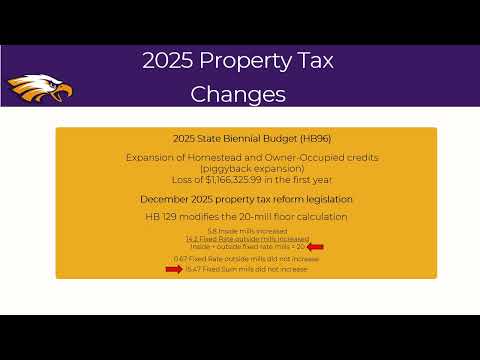
Fox explained that some levies — including the district's reported 5.8 inside mills and 14.2 fixed-rate outside mills — are covered by Ohio's statutory 20-mill floor that prevents certain mills from being reduced below 20. Because of that statutory floor, she said, increases in property values can generate higher taxes for mills counted toward the floor.
She told listeners that the updated valuations first appeared on 2025 tax bills and that district revenue increased by more than $4 million from fiscal year 2024 to fiscal year 2025 as a result. "This increase in revenue followed the law and therefore was expected," she said.
Fox then outlined several 2025 state-level bills she said will change how future tax growth is calculated. She described a provision in the signed biennial budget (House Bill 96) that allowed county budget commissions to expand homestead and owner-occupied tax credits (a so-called piggyback expansion). She said the county implemented that expansion to begin in January 2026 and that because the county-level expansion is not reimbursed by the state, "Avon Local Schools will see a revenue reduction of over $1.16 million in the first year."
Fox described House Bill 129 as changing how the 20-mill floor is calculated beginning with Avon's next valuation update in 2027: most fixed-sum levies (she said about 12 of the district's 15.47 fixed-sum mills, excluding bond levies) will count toward the 20-mill floor, which she estimated would push the district to roughly 32 mills toward that threshold. When that happens, she said, future increases in property values will not generate additional revenues from those included mills because reduction factors will bring them back down toward the 20-mill level.
She also summarized House Bill 335, saying it will limit growth of the district's 5.8 inside mills by capping annual increases at the GDP deflator; if property values rise faster than that deflator, the inside millage will be reduced to match the deflator.
Fox said House Bill 186 creates temporary inflation-cap credits for districts at the 20-mill floor and authorizes revenue-guarantee payments to cover credits for tax year 2025. She said Avon will receive a retroactive inflation-cap credit on second-half 2026 tax bills but added that the guarantee payment will be funded through cancellation of the 2026 sales tax holiday, and therefore "the inflation cap credit for Avon property owners will not impact the district's revenue in 2026."
For property owners, Fox said qualifying residents saw piggyback homestead and owner-occupied credits on their January 2026 bills, and will see similar piggyback and inflation-cap credits on second-half 2026 bills, but that inflation-cap credits are temporary and will end once other legislation moves the district above the 20-mill floor.
On district finances, Fox said the district faces an immediate reduction in anticipated revenue for 2026 because of the piggyback expansion and expects further limits on future growth because of changes to the 20-mill calculation and the GDP-deflator cap. She emphasized the board and administration are planning to manage the changes and "are working diligently to ensure our district remains fiscally responsible without disrupting any services for students."
Fox closed by offering contact information and the district website for residents seeking more detail.