Get Full Government Meeting Transcripts, Videos, & Alerts Forever!
Get email alerts on the Planning Station Area topic
No spam. Unsubscribe anytime.
Kirkland council delays station‑area zoning changes after debate over town‑home ban
Summary
Council postponed vote on Ordinance 4936 after a contentious debate over a proposed town‑home prohibition used to enforce a minimum‑density objective in the Northeast 85th station area. Planning Commission recommendations and a multi‑point exemption for near‑vested projects were central to the discussion.
The Kirkland City Council on April 21 postponed final action on a package of station‑area zoning changes after members deadlocked over a proposed town‑home prohibition designed to implement a minimum density in the Northeast 85th Street station area.
Planning staff and the Planning Commission recommended ordinance 4936 to activate the station area and incentivize higher‑density development near planned transit investments. The package included three main changes: clearer rules allowing development agreements that could unlock additional height or uses, a proposed prohibition on detached and attached single‑family town homes across several station‑area zones (as a means of establishing a minimum density), and an extension to affordable‑housing provisions through 2029 for projects that file earlier.
The Planning Commission added two clarifying items after public hearing testimony: language removing a four‑acre threshold so development agreements can apply to parcels of any size, and a one‑time carve‑out allowing the Rose Hill town‑home project to proceed if complete building permits are submitted within nine months of ordinance adoption. Staff also noted that existing town homes in the district would remain legal nonconforming uses, with limited ability to expand under current code.
Debate at council focused on the town‑home prohibition. Council Member Pascal urged removing the minimum‑density ban, arguing it introduces regulatory uncertainty and could deter investment. “Instead of limiting certain types of development, we should be focusing on incentivizing the kinds of development we want,” Pascal said. Other council members, including Council Member Tim Chisen and Mayor Kelly Curtis, argued the rule is intended to preserve the station‑area vision — higher density close to future transit — and pointed to an escape hatch: development agreements can still be used to approve alternate outcomes.
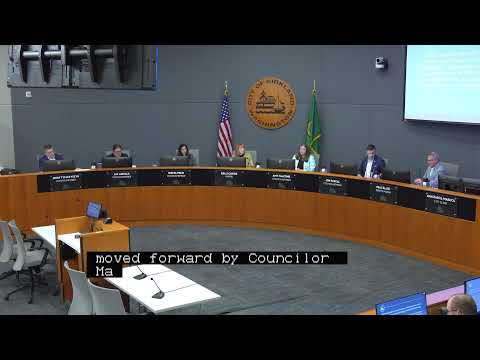
After extended discussion, Council Member Tim Chisen moved to postpone the ordinance to the May 5 meeting to give council and staff time to draft and test specific amendments. The motion to postpone passed 4–3, meaning the council will revisit the item with possible amendments at its next meeting.
Planning staff urged the council that the ordinance package is intended to catalyze development in the long‑planned transit‑adjacent station area and remains coupled with other city efforts (incentives, economic development outreach) to attract projects.