Get Full Government Meeting Transcripts, Videos, & Alerts Forever!
Get email alerts on the Flag Policy topic
No spam. Unsubscribe anytime.
Lake Bluff trustees debate flag-display rules, narrow special-event permits
Summary
At an April 13 committee meeting, Lake Bluff trustees reviewed options to limit special events to short, sponsored occasions (typically 24 hours to three days) and weighed three flag-display approaches — document status quo, case-by-case government flags, or opening displays more broadly — while hearing a public plea to let a Pride-related tree-wrapping remain longer.
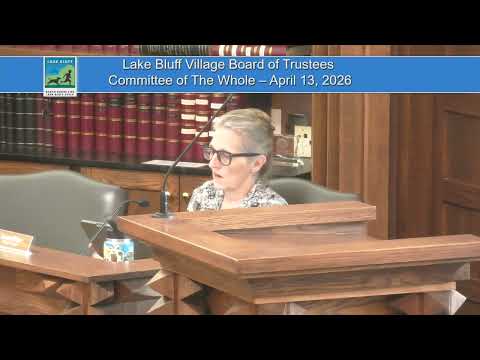
Lake Bluff's committee of the whole reopened a debate on special-event permits and the village's flag-display policy on April 13, 2026, as trustees sought a balance between protecting residents'sense of tranquility and honoring inclusive community displays.
President Charlotte opened the meeting and said her goal was to reach a decision that evening, noting a subcommittee of trustees and staff had prepared options for the board to consider. Subcommittee members and staff reviewed the village's guiding documents (the 2026 strategic plan and the brand platform), summarized prior public comments, and framed three distinct approaches to how the village might manage flags on village poles.
Why it matters: trustees said the question pits two widely shared values'preserving the village'character and being welcoming to historically marginalized residents'against each other in practical policy terms. The legal distinction trustees repeatedly invoked was between government speech (where the village selects what to display) and a public forum (where allowing private displays can compel the village to permit any speaker under First Amendment doctrine). Several trustees warned that designating a public forum can create long-term legal obligations that are difficult to unwind.
Most trustees signaled support for tightening the special-events process to focus on active, sponsored events rather than long-term unattended displays. Staff and several trustees recommended that a typical special event be limited by default to 24 hours, with the possibility of board or administrative approval for events lasting up to three days. That approach would also require a local sponsor or responsible party for events on the village green and would restrict unattended or permanently planted signage that had appeared in earlier controversies.
On flag policy, staff presented three choices: (A) keep the informal status quo (no government flags beyond official flags); (B) adopt a written policy that documents the current government-only approach while creating a small holiday/celebration package for routinely accepted displays; or (C) adopt a broader policy that either considers requests case-by-case (C1) or opens the flag poles to all displays (C2). Trustees who favored B said it preserves village control of government speech while creating a limited mechanism to accept traditional holiday displays (for example, U.S., Illinois and municipal flags and a limited holiday package). Proponents of C1 argued a managed, case-by-case acceptance process would allow the village to be more inclusive while retaining discretion; trustees who cautioned against C2 noted that opening a forum to "all displays" would legally transform the space into a public forum with attendant constitutional limits.
Village Attorney Freeman and others cited examples from other municipalities and court decisions to underline the legal stakes. "Once you have a public forum, you have to live with it," one attorney explained, noting the village could find it difficult to restrict content later.
Public comment underscored the human effect of the debate. A resident who identified herself as Jennifer described a recent tree-wrapping event tied to Pride month that drew families and children, calling the installation "a creation" and saying it communicated, "You are safe here." She asked the board to consider allowing such community-made displays to remain for a week or two instead of being removed after a single day.
Next steps: staff proposed returning to another workshop (targeted for April 27) with draft language: an amended special-events policy reflecting the 24-hour default with a path to three-day approvals, and a draft flag policy consistent with the board's leaning toward option B (document status quo with a holiday package) plus optional standards for handling gifts and requests. Several trustees asked for more time because two members were absent and to ensure broader consensus before a final vote.
Formal actions: the committee approved minutes from the Feb. 9, 2026 meeting earlier in the session and adjourned at about 7:20 p.m.; no final vote on the flag or special-events policy was taken. The board instructed staff to draft specific ordinance/language and return with options for further discussion.
Looking ahead: trustees said the next workshop will focus on specific language for time limits, sponsorship requirements, permissible content restrictions tied to public-safety concerns, and a clear administrative process for considering gifts or requests for non-government flags.