Get Full Government Meeting Transcripts, Videos, & Alerts Forever!
Get email alerts on the Land Use Data Center topic
No spam. Unsubscribe anytime.
Hildebrand residents raise alarms about proposed data center’s water, power and noise impacts
Summary
Residents of Hildebrand told the Burke County Board of Commissioners they fear a proposed data center near Klein Park will overwhelm local water supplies, strain the electrical grid, raise noise levels and bring few permanent jobs; the board said local municipal planning processes will determine the project’s path.
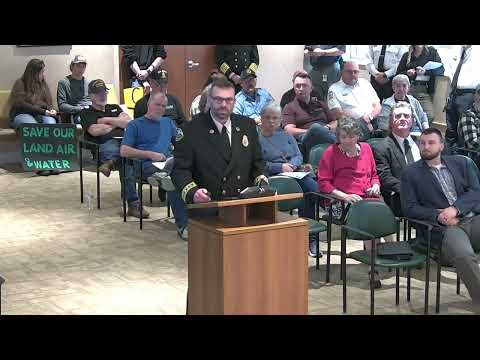
Residents of Hildebrand pressed commissioners on April 20 over a proposed data center they say would sit near Klein Park and adjacent neighborhoods, raising concerns about water use, electricity demand, noise and air pollution.
“My home is about 800 households; a 200-megawatt facility could use the equivalent of power for 133,000 homes,” said John Clark, who identified himself and his address during informal public comment and presented calculations he said were based on company proposals for a 200-megawatt plant. Clark said the center’s water demand could reach “upwards of 800,000 gallons a day” for a 200-megawatt facility and warned residents could face higher rates and service strain. He also said continuous cooling fans and chillers could raise noise well above typical residential levels.
Belinda Klein, another resident, told the board that promises of closed-loop cooling do not eliminate evaporative loss, blowdown and contamination risks, and warned of potential impacts to wells and local waterways. “There is really no such thing as a closed loop system,” she said, urging the county to protect water, land and children’s future.
County leaders acknowledged the concerns but clarified jurisdictional limits. The chair told commenters the municipal (town) planning and zoning process for Hildebrand carries primary authority over local land-use approvals, and the county’s role is limited when a town has its own planning and zoning body.
Why this matters: Data centers can demand large, steady amounts of electricity and water for cooling; nearby residents raised immediate local-service and public-health concerns and asked the county to weigh siting decisions against community impacts. Commenters also questioned economic benefits, saying construction brings few permanent local jobs and that long-term burdens—utilities, noise and environmental risks—could fall on residents.
What the board said it would do: Commissioners thanked residents for attending, noted the county’s limited jurisdiction where municipal zoning applies, and proceeded with the rest of the agenda. No county action on the project was taken at the April 20 meeting.
Claims and status: Clark and Klein presented specific numerical claims about power, water and noise. The claims were framed as commenter analysis and were not independently verified during the meeting. The commission did not rebut or substantively verify the numbers and indicated that municipal planning boards will lead formal land-use review.
Next steps: Those concerned about the project were advised to follow the town’s planning and zoning process and any future county actions. The Board moved on after the public comment period and took no formal action on the data-center proposal at this meeting.