Get Full Government Meeting Transcripts, Videos, & Alerts Forever!
Get email alerts on the Short Term Rentals topic
No spam. Unsubscribe anytime.
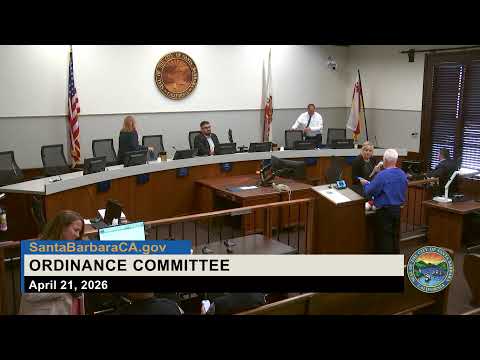
Santa Barbara committee hears hours of public comment and splits over proposed short‑term rental rules
Summary
Dozens of residents, hosts and stakeholders urged the Ordinance Committee to either ban, grandfather or substantially revise a proposed short‑term rental ordinance; committee members asked staff for targeted redlines on fire‑hazard bans, home‑share rules and licensing details before taking further action.
Dozens of residents, short‑term rental hosts and industry representatives filled the Santa Barbara Ordinance Committee meeting on April 21 to debate a proposed ordinance that would sharply limit unhosted short‑term rentals (STRs) in the city’s residential and coastal zones.
The committee reopened public comment and set a two‑minute limit per speaker. Neighbors from Yankee Farm and the Mesa described narrow, single‑access roads and dense vegetation and urged prohibitions on STRs in extreme‑ and high‑fire hazard areas. "We have only one narrow road for both entry and evacuation," said Eve Leeds, representing about 20 neighbors on Yankee Farm, urging that safety outweigh tax revenue arguments.
Other residents recounted repeated late‑night parties, noise complaints and police calls. "These STRs are like mini‑motels where everybody stays in one room," said Bill Stark, who asked the committee not to allow STRs in parcels zoned for single‑family residential use. At the same time, numerous hosts described family‑run operations that pay transient occupancy tax (TOT) and provide income that allows them to remain in the city. "This is our livelihood," said Irwin Green, noting he had paid TOT “from day one.”
Industry and legal speakers urged caution and additional analysis. Steve Leonard, an associate attorney with Angel Law, told the committee that the staff report’s categorical exemption from environmental review lacked supporting evidence and that the ordinance could push visitors to farther destinations, increasing vehicle miles traveled. The California Short‑Term Rental Association and local host groups pressed for grandfathering, clearer fee schedules, registration and alternatives such as caps or density‑based systems.
Committee members voiced a mix of priorities. Mayor Pro Tem Pertim Snetten said home shares could be allowed in more places but asked that STRs be banned in extreme/high‑fire zones for safety. "It’s not about parking or TOT. For me it’s about stability of neighborhoods," he said. Council member Jordan asked staff to produce a clear, line‑by‑line explanation of how the ordinance would create a "viable pathway" for compliant operators and to consider whether applicants should be required to have purchased a business tax certificate before license issuance or only as a condition of approval.
Council members pressed staff for clarity on several implementation points: the effect of owner‑host versus property‑manager responsibilities, how platform collection and remittance of TOT would be implemented, the scope and timing of fee recovery for application and ongoing compliance, definitions of noise and amplified‐sound limits, and indemnification/litigation risks tied to license approvals.
On process, multiple speakers and some council members urged the committee not to rush. Several committee members asked staff to return with a redlined ordinance that (1) clarifies language to enable STRs in zones intended for visitor accommodations, (2) includes maps and fire‑hazard layers to show where bans would apply, and (3) specifies fee schedules and the application sequence (pre‑application counseling, licensing fees, and any refund policy for incomplete applications).
What’s next: the committee directed staff to return with targeted redlines, a fire hazard map and additional implementation details before moving the ordinance to a council vote. The committee did not take final action on the STR ordinance at this meeting.
Quotes (selection): "We have only one narrow road for both entry and evacuation," Eve Leeds said, urging prohibitions in Yankee Farm. "These STRs are like mini‑motels," Bill Stark said, arguing STRs don’t belong in single‑family residential parcels. "The ordinance is incomplete and not sufficiently supported by actual data," said Theo Kraki, urging more study and alternative regulatory approaches.
Ending: Committee members closed the public‑comment portion for this item and asked staff to draft redlines and return to the ordinance committee for further consideration, allowing additional public comment on any revised proposal.