Get Full Government Meeting Transcripts, Videos, & Alerts Forever!
Get email alerts on the Waste Management topic
No spam. Unsubscribe anytime.
Industry witnesses tell House committee Bill 630 would strain Puerto Rico's tire-management fund
Summary
At a April 20, 2026 hearing on PDLAC 630, tire exporters and processors warned the bill's 40% local-processing mandate and proposed transporter payments could materially increase annual payouts from the tire-management fund and favor a single local processor. Witnesses urged the commission to obtain Treasury import/payment data before adopting mandates.
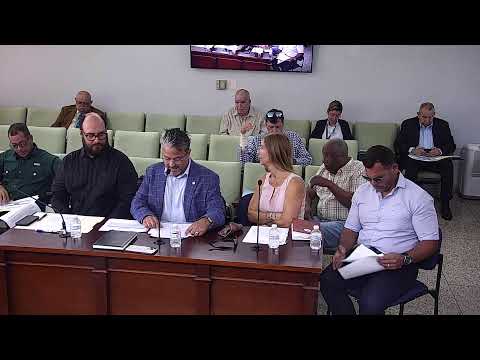
SAN JUAN — The House Commission on Natural Resources held a second public hearing on April 20, 2026 on PDLAC 630, a bill to amend Puerto Rico's tire-management statutes to require a minimum share of discarded tires be processed locally and to allow transporters to collect fees from the disposal fund. Industry witnesses including José A. Rodríguez of Prospero Tire and engineer Edgardo Velázquez of JDJ Recycling told the committee the measure, as written, could sharply increase costs to the government-managed disposal fund and risk favoring a single local processor.
The bill's author, Representative Emilio Carlos Acosta, was present during the hearing. The chair opened the session by summarizing the bill's intent: to establish a minimum percentage of discarded tires destined for local processing and recycling, to recognize transporters as eligible for collection, and to promote the use of locally recycled products in government-funded road projects.
Why it matters: Witnesses said the combination of a 40% local-processing mandate and reinstatement of separate transporter payments — on top of existing per-pound tariffs — could raise per-container and annual fund outlays to levels that exceed current receipts. That, they warned, could force higher handling charges for importers or deplete the fund that pays for tire collection and disposition.
Key claims and numbers: José A. Rodríguez, representing Prospero Tire, reviewed the law's evolution from Law 171 (1996) through Law 41 (2009) and more recent amendments. He said current tariff practice pays exporters of whole tires 9 cents per pound while processors and recyclers receive roughly 15–15.6 cents per pound. Using figures he presented—19 pounds per tire and about 60,000 pounds per export container (roughly 3,158 tires)—Rodríguez estimated per-container payments under different tariff scenarios and projected annual outlays assuming roughly 4 million discarded tires per year (he also cited a 2025 figure near 4.94 million). Under those assumptions he calculated fund expenditures that in his presentation ranged from several million to more than $13 million annually depending on the tariff and proposed add-ons.
"Con este proyecto ley se pretende traer nuevamente la figura del transportista... Esto va a desangrar el fondo," Rodríguez said, arguing the bill would effectively raise costs and risk monopolistic outcomes benefiting a single local processor that has already received sizable fund payments.
Technical and market context: Engineer Edgardo Velázquez, representing JDJ Recycling and Rford Enterprise, identified himself for the record and described decades of work on rubber recycling and rubber-modified asphalt projects. Velázquez said the technical use of rubber in road mixes exists and that prior pilot projects and Department of Transportation specifications are in place, but he emphasized that mandates will not succeed without commercial viability and market commitments. "La legislación por mandato no funciona a menos que el negocio sea lucrativo para las empresas," he said.
Data and transparency requests: Multiple presenters urged the commission to request detailed Treasury (Hacienda) import-entry and payment data to understand actual fund inflows and which companies received how much in 2024 and 2025. Rodríguez and Velázquez pointed to public payment tables and company-level figures but said a complete accounting from Hacienda is needed to assess whether the fund could sustain the bill's changes.
Other objections raised by witnesses: witnesses said (1) the 40% local-processing target would be difficult to implement because there are only a small number of processors in Puerto Rico; (2) adding transporter payments was previously removed by law (Law 135 of 2011) after enforcement abuses and would reintroduce administrative burden and fraud risk; and (3) higher per-pound payments for processed material can create incentives to export processed material rather than recycle locally unless specific local-market arrangements exist.
Procedure and next steps: The chair made procedural remarks on recordkeeping and decorum and said written submissions would form part of the commission's file. At about 10:23 a.m. the hearing was recessed for a technical problem and the commission said it would continue in another hearing room later the same day. No vote or committee action on PDLAC 630 was taken at the session.
The witnesses asked the commission to obtain and review Treasury import/payment records and to coordinate with agencies and industry to craft implementation details before adopting a 40% quota or restoring transporter payments.