Get Full Government Meeting Transcripts, Videos, & Alerts Forever!
Get email alerts on the Children Mental Health topic
No spam. Unsubscribe anytime.
Committee hears proposal to plan a 30‑bed psychiatric residential treatment facility for children
Summary
Lawmakers heard testimony supporting House File 4896, which would fund pre‑planning for a 30‑bed secure psychiatric residential treatment facility (PRTF) for children, with witnesses citing long waits, out‑of‑state placements and lost residential capacity.
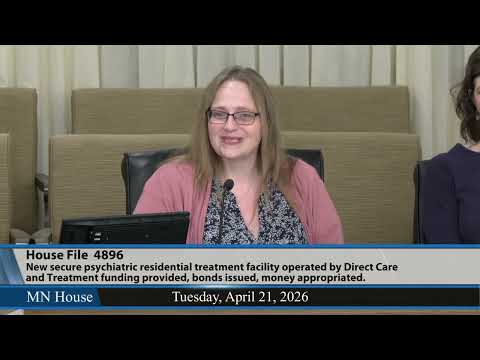
The Minnesota House Capital Investment Committee heard testimony on House File 4896, a request to fund pre‑planning for a 30‑bed psychiatric residential treatment facility for children. Representative Hicks introduced the bill and called witnesses to explain gaps in the state's continuum of care.
Kirsten Anderson, executive director of Aspire Minnesota, told the committee that Minnesota has “too many gaps in our children's mental health system,” saying the state has lost residential treatment capacity over the past two decades and currently lacks sufficient options for children with severe aggression and self‑harm behaviors. “When children and families get the care that they need, they do better outcomes improved for the short and long‑term children's mental health care improves and saves lives,” Anderson said.
Nancy Freeman, operations services chief operating officer for Direct Care and Treatment (DCT), described the bill as an early step in a multi‑stage process. She said the funding in House File 4896 would support pre‑design and design work for a secure, state‑operated facility and cautioned that pre‑design and design could take 18 to 24 months. Testimony to the committee also cited recent data showing long waits for high‑acuity placements — roughly three to nine months on average and in some cases more than a year — and noted that counties have been sending children to out‑of‑state facilities; committee materials cited county spending on those placements in recent reporting approaching $80 million.
Witnesses and representatives emphasized that a single state facility would not solve all gaps; they described the proposal as one element in a broader strategy that also requires community capacity, earlier intervention and sustained investment. Freeman said DCT would return to request construction and operating funds in a future session if pre‑design proceeds.
The committee did not take an immediate funding vote on construction; members asked DCT staff to provide additional cost and timeline information as the planning phase advances.