Get Full Government Meeting Transcripts, Videos, & Alerts Forever!
Get email alerts on the Streets Pavement topic
No spam. Unsubscribe anytime.
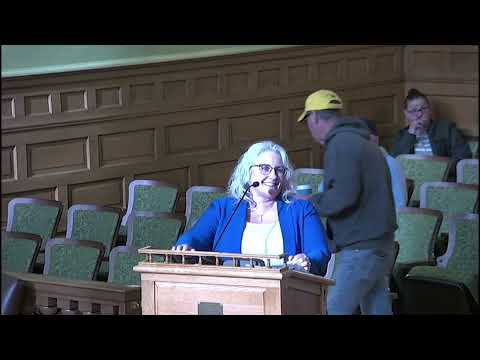
Engineering manager Rachel Phillips: Bay City roads will keep deteriorating unless funding increases
Summary
Rachel Phillips told the Bay City commission the city’s road network — valued at roughly $600 million — is largely in poor condition and that current annual funding of about $2 million will not prevent continued decline; she said $15 million a year would be needed to bring the system to a fair condition over 20 years.
Rachel Phillips, the city’s engineering manager, told the Bay City commission on April 20 that the municipal street system is ‘‘valued at approximately $600 million’’ and that under today’s funding the network will continue to worsen.
Phillips said the city’s annual road construction budget is roughly $2 million — about one-third of the investment that typically goes into projects once grant matches are included — and that the pavement condition measured by the PASER system shows about 73% of the network in the ‘‘poor’’ category. ‘‘If the road is left alone over the 20 years, it will need to be reconstructed in 20 years at over 2.1 million,’’ she said in the presentation.
Why it matters: City pavement condition is driven by the long-term mismatch between maintenance needs and available funding. Phillips showed a 20-year life-cycle comparison demonstrating that routine, timely maintenance is dramatically less expensive than deferred reconstruction. She told commissioners that, in the city’s model, an investment of roughly $15 million per year over 20 years would be required to raise the system to an overall ‘‘fair’’ condition; at the current $2 million annual level the system’s average PASER score will decline.
Commissioners pressed for details on which funds count as ‘‘city’’ revenue and how grant matches are handled. Phillips said about 93% of the city’s $2 million road budget comes from Act 51 distributions — the state gas-tax/vehicle-registration formula — and the remaining local contributions come from non-tax sources such as permit fees, scrap sales and a portion of marijuana revenue when available. ‘‘We always use our 2 million, but right now I have 20% of our Henry project budgeted out of our budget because it’s an 80% match grant,’’ Phillips said, explaining that the city sometimes budgets a portion of a local project to unlock larger grant funding.
UBP funds and grant strategy: Phillips described a $5 million payment from United Bridge Partners (UBP) the city recently received. She said the plan is to use up to half of that funding as a capped annual match to leverage grants and support a sidewalk program, allowing the city to free up regular budget dollars for other work. ‘‘It allows us to use more of our regular city budget and not have to worry about if we get a grant, can we actually match it with what we have?’’ Phillips said.
Open questions and trade-offs: Commissioners asked whether the figures in the presentation reflect fiscal-year timing versus construction seasons, how much was previously spent on bridge maintenance, and how reliable grant streams are going forward. Phillips acknowledged federal and state grant criteria change year to year and said the city’s new grant writer has expanded scoping for potential projects. Commissioners discussed millage options: staff estimated roughly $750,000 per mill, meaning a roughly three-mill local property tax increase (about $150 a year on a $100,000 house with $50,000 taxable value) would materially close the gap toward a ‘‘fair’’ system.
What happens next: The presentation and Q&A were received; commissioners indicated they will continue discussing funding options, including examining marijuana-revenue allocations and possible millage proposals in future budget work sessions. The commission did not take formal action on the asset-management plan at the meeting.