Get Full Government Meeting Transcripts, Videos, & Alerts Forever!
Get email alerts on the C406 Credits topic
No spam. Unsubscribe anytime.
MVPE committee forwards two competing C406 energy-credit proposals to Building Code Council
Summary
The MVPE committee voted to forward both David Reddy’s revised (version 3) and Gregory Johnson’s credit requirement tables for C406 to the full Building Code Council for review and CR102 drafting, after debate over climate-zone weighting, lab weighting, and how base code changes affect system-level stringency.
The Washington State Building Code Council’s MVPE committee voted to forward two competing C406 energy-credit proposals to the full Council for review and inclusion in draft CR102 language.
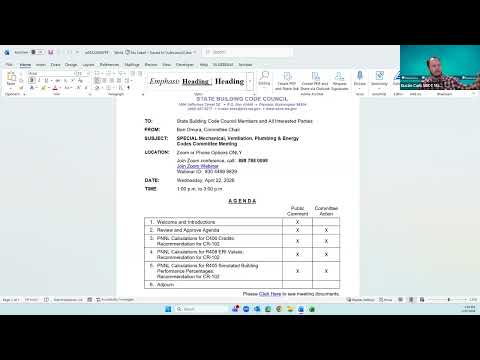
Krista Braaksma, staff to the Building Code Council, told the committee the C406 items before them included C406.2 (credit values calculated by PNNL with some editorial changes) and C406.1 (the number of credits required). She said remaining PNNL calculations would likely surface during the public hearing process.
Gregory Johnson of Avista, who prepared extensive analysis and annotated graphs, asked the committee to ignore a lab column that received zero weighting and said the credit table should treat most B occupancies the same. "You could just ignore that lab column," he said, explaining his revisions only reorganized presentation and added clarity about what counts as low-, medium- and high-cost credits.
David Reddy (O'Brien360) said his version 3 proposal narrows differences between the two climate zones and results in about "a half, or a little over a half percent more savings for the state," while aiming to distribute those savings more evenly between zones. Reddy recommended forwarding only his version 3 if the committee preferred a single option, but committee members preferred sending both for Council-level debate.
Stakeholders debated whether recent base-code changes (increased UA values and lower lighting power densities) effectively embedded savings into the code rather than via credits. Johnson said the modeling by PNNL and P&L captures energy-use savings across the building, while Reddy cautioned that some system-specific requirements present in the 2021 code may not be required under the new credit-based approach.
Katy Sheehan moved to forward both David Reddy (version 3) and Gregory Johnson's credit requirement tables to the Council; Scott Bastiani seconded. The committee voted by voice and the chair declared the motion carried; staff will draft the forwarded materials into CR102 language for the Council agenda.
The Council will now review both proposals during its upcoming meeting and the CR102 public comment period, where remaining modeling inputs from PNNL are expected to be available.
The committee action does not itself adopt code; it forwards the two proposals for Council deliberation and public review.