Get Full Government Meeting Transcripts, Videos, & Alerts Forever!
Get email alerts on the Housing topic
No spam. Unsubscribe anytime.
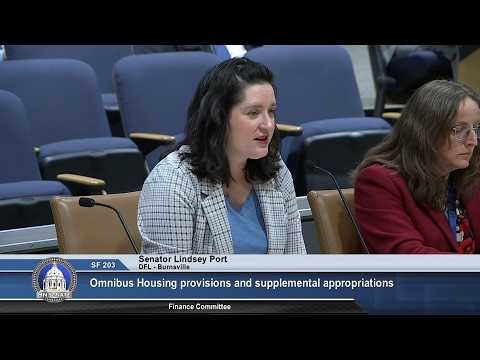
Senate Finance advances broad housing package with HIBS, manufactured-home protections and private-equity limits
Summary
The Senate Finance Committee recommended passage of Senate File 203, a housing package that authorizes $50 million in Housing Infrastructure Bonds, updates MHFA rules, and includes manufactured-home protections and new limits on large private‑equity acquisitions; the committee adopted several technical and fiscal amendments before advancing the bill to the floor.
Senate File 203, a comprehensive housing package that sponsors say will expand affordable housing and protect residents of manufactured‑home communities, was recommended to pass by the Senate Finance Committee on April 21.
Sponsor Sen. Port opened by saying the bill includes a $50 million Housing Infrastructure Bonds (HIBS) authorization, MHFA administrative clarifications, an exemption for income earned by lived‑experience consultants when determining eligibility for other public assistance, workforce‑housing eligibility updates for certain infrastructure grants, and reforms to MHFA investment practices. "This bill creates meaningful change that will help Minnesotans afford a safe and stable place to live," Sen. Port said.
Fiscal analyst Erik Olaphson reviewed the committee spreadsheets and debt‑service projections, saying a $50 million HIBS authorization would add modest recurring debt‑service costs beginning in FY2029 and estimated total debt service for that authorization at roughly $75.8 million over time. Olaphson noted current biennial debt‑service payments for housing infrastructure bonds are already substantial and provided line‑item detail to the committee.
Committee members debated several technical and policy amendments. A technical correction (A21) to clean up drafting errors and conform language from the Judiciary Committee was adopted by voice vote. Sen. Draheim’s A20 amendment, which analysts and supporters described as increasing legislative oversight of MHFA fund flows and pushing for faster program implementation, was also adopted; Draheim said it sought to ensure authorized programs move more quickly into service. Sen. JASINSKI offered an amendment (A23) that would have redirected MHFA interest earnings to workforce homeownership and other programs; Sen. Port opposed that change, arguing MHFA relies on interest earnings to fund agency operations and that diverting the fund would create an ongoing operations shortfall; that amendment did not prevail.
A contentious exchange centered on a Dodd‑style manufactured‑home provision carried by Sen. Boldon and included in SF 203. Sen. Draheim offered A22 to strip the manufactured‑housing policy language from the finance bill on the ground that it is policy, not finance; supporters of the manufactured‑home language urged that the provisions protect residents who own homes but not the land beneath them and cited examples of steep rent increases, failing infrastructure and out‑of‑state private‑equity owners raising costs. Opponents warned the rules could act as de facto price controls and hamper access to financing. The committee held a roll call on the A22 amendment; the motion failed (roll call recorded 5 yeas, 7 nays) and the manufactured‑housing provisions remained in the bill.
After adopting technical and oversight amendments, the committee voted to recommend Senate File 203 as amended be passed and instructed staff to make technical and conforming changes. Sen. Frentz made the motion to advance the bill; the motion carried.
What’s next: SF 203 will be transmitted to the Senate floor with the committee’s recommendation. The committee record shows the $50 million HIBS authorization and the manufactured‑home protections remain in the bill as it moves forward.