Get Full Government Meeting Transcripts, Videos, & Alerts Forever!
Get email alerts on the Shoreland Overlay topic
No spam. Unsubscribe anytime.
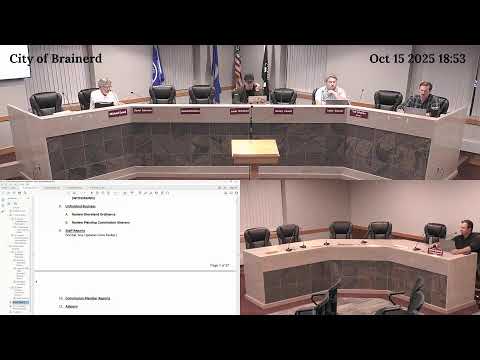
Planning commission advances shoreland overlay revisions, agrees to negotiate standards with DNR and to use interim permits for extractive/mining uses
Summary
Brainerd City’s planning commission reviewed an amended shoreland overlay ordinance, agreed to seek DNR negotiation on non‑riparian lot size and public‑use classifications to avoid nonconforming properties, endorsed interim‑use permitting for extractive operations, and moved metallic‑mineral and peat mining to interim‑use status.
The Brainerd City Planning Commission advanced a package of revisions to the city’s shoreland overlay ordinance, directing staff to negotiate select standards with the Minnesota Department of Natural Resources (DNR) and approving interim‑use permit treatment for extractive and certain mining activities.
Staff explained an amended ordinance had been circulated to fix clerical errors, standardize terminology (changing “shore impact zone” to “SIS”), revise the uses table, add riparian and non‑riparian lot‑size and width standards based on the DNR model ordinance, and move PUD rules into the zoning code’s administration section. Staff said the city must file a comprehensive plan with the EQB chair that includes prescribed elements, and that some shoreland standards dated from 2003.
Commissioners raised several substantive concerns. Commissioner Duval urged staff to negotiate with the DNR on minimum lot sizes for non‑riparian lots to avoid creating many nonconforming properties in built areas, saying the city should "direct staff to work with the DNR on these minimum lot sizes on the non‑riparian stuff." Commissioners noted Brainerd sits between the DNR definitions of a ‘‘forested river’’ and an ‘‘urban river,’’ and that classifying public/semi‑public uses (for example, hospitals, schools, college facilities, and the water plant) as conditional in forested river zones could inappropriately tag existing public facilities; commissioners asked staff to seek agreement with DNR where appropriate.
On extractive uses (sand, gravel, aggregate), staff and commissioners discussed that the 300‑foot river buffer can be narrow and that large extractive operations could occupy much of that buffer. Staff recommended using interim‑use permits as a regulatory tool that is more restrictive than the DNR sample ordinance and that allows time limits and removal conditions; the commission voted to accept staff’s recommendation and to have staff discuss the approach with DNR.
Commissioners also debated metallic mineral and peat mining in shoreland zones. Several members said mining inside city limits was not appropriate; the commission voted to change metallic‑mineral and peat mining to interim‑use permit status across the board so such activities would require review and could be time‑limited or revoked by the city.
Votes and next steps: motions to accept staff recommendations for extractive uses and to treat metallic‑mineral and peat mining as interim uses were both seconded and passed by voice vote. Staff will negotiate the contested technical standards with the DNR, revise the ordinance language as directed, and return a final packet to the commission for further review and for DNR review before the public hearing and council action.