Get Full Government Meeting Transcripts, Videos, & Alerts Forever!
Get email alerts on the Land Use Stfrancis topic
No spam. Unsubscribe anytime.
City Council approves St. Francis plan, vacates Ninth Street and rezones parcels for school expansion
Summary
After a lengthy public hearing with mixed public comment, Brainerd City Council adopted a resolution vacating a segment of North Ninth Street, approved preliminary and final plats, rezoned multiple parcels to PSP (public/semi-public) and granted conditional-use permits to allow construction of a rectory and future school expansion tied to St. Francis Catholic Church and School.
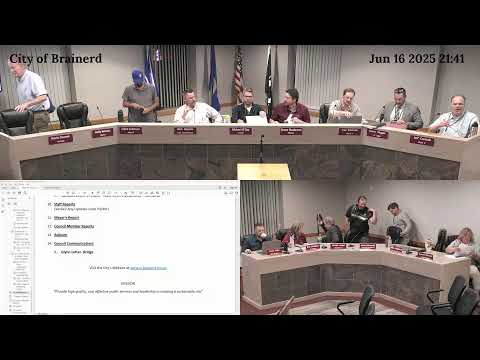
Brainerd City Council voted June 16 to vacate a segment of North Ninth Street and to approve associated plats, rezoning and conditional-use permits that will allow St. Francis Catholic Church and School to consolidate parcels and proceed with a master plan for school expansion.
The council adopted the street-vacation resolution while reserving utility easements after roughly 90 minutes of staff presentations and public comment. Father Michael Gary, representing St. Francis, said the changes are necessary to improve safety and enable the school to expand to include high-school grades. "We enjoy being in the city of Brainerd, been here 150 years," Father Gary said, arguing the vacation would create shared neighborhood amenities such as playground and courts.
City planning staff and the city engineer presented the interconnected land-use package: vacating North Ninth Street between Juniper and Ivy; preliminary and final plats to combine 14 parcels into three; rezoning from TN1 (Traditional Neighborhood 1) to PSP (Public/Semi-Public); and conditional-use permits to permit a rectory on a parcel under one acre and to allow demolition of three parish-owned homes that otherwise would be restricted in TN1.
Opponents at the public hearing urged caution. Longtime resident Chuck Marone said the plan would convert a historic neighborhood into a "campus," reduce circulation options and weaken public-safety redundancy. "When we start closing streets...we systematically start to devalue the public safety response," Marone said, urging council to require phased planning and additional studies.
Architect Erica Marcus (Woods) and parish leadership presented circulation and parking details intended to offset loss of on-street spaces: a reconfigured lot with roughly 36 on-site spaces plus about 20 diagonal spaces on Ivy Street, together representing a net increase in parking compared with the current configuration, staff said. Marcus also described a bus queuing inset sized for four buses and said planned pedestrian connections would be retained.
Council members debated competing priorities: neighborhood character and the risks of spot zoning versus school safety and community investment. Councilman Jagger voted no on several items, citing loss of housing and the need to preserve existing ordinances that limit demolition. The vacation resolution passed on roll call (6–1: Chzach, Johnson, Stunic, Ericson, Bevans, O'Day yes; Jagger no). Subsequent votes approved the preliminary and final plat, rezoning ordinance 1584 and the conditional-use permits, each with recorded contingencies.
Under staff recommendations, approvals are contingent on development agreements and conditions listed in the staff report, including preservation of utility easements and other mitigation measures. Council members said the development agreement that follows will be the forum to nail down fencing, parking configuration and maintenance responsibilities.
The council’s approvals allow St. Francis to proceed with engineering and design work required for construction. Next steps include execution of a development agreement and final permits; council directed staff to return with contract and agreement language that memorializes the conditions discussed during the hearing.