Get Full Government Meeting Transcripts, Videos, & Alerts Forever!
Get email alerts on the School Budget topic
No spam. Unsubscribe anytime.
Hamilton Central presents 2026-27 budget with 2.26% tax-levy increase, no layoffs planned
Summary
The Hamilton Central School District proposed a 1.05% spending increase for 2026-27 with a tax-levy increase of 2.26%; district leaders said programs and positions are preserved, several retirements will be absorbed through attrition, and public budget presentations and a formal hearing precede the May vote.
Matt opened the Hamilton Central School District's budget presentation by saying the proposed 2026-27 spending plan would increase total spending by 1.05% while using the allowable tax-levy cap of 2.26%.
"It's not cutting any programs or any offerings. It's not cutting any people's positions. Nobody's being laid off," Matt said, explaining the proposal preserves current programming while recognizing several staff departures at the end of June.
The presentation laid out the district's rationale for a levy increase that outpaces spending growth. Matt said the district is reducing reliance on reserve funds and winding down federal pandemic-relief dollars. He said a prior four-year plan anticipated using about $750,000 in reserves; next year that planned reserve draw will be reduced by $75,000, removing a revenue source the district used in prior years.
The budget uses the required three-part format: program (instructional and most spending), administrative (board and central-office costs, audits, insurance and BOCES-provided services), and capital (operations and debt service). Matt explained administrative costs include BOCES labor-relations and personnel services.
Personnel-related costs are the chief drivers of the budget, he said. Health-insurance premiums are budgeted to rise roughly 7%, which Matt estimated equals about $225,000 — an amount larger than the additional revenue produced by the allowable tax-levy increase.
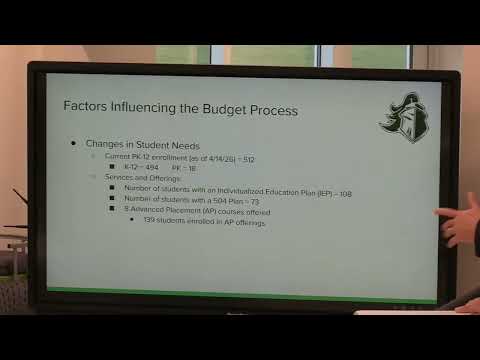
Enrollment trends also shaped the discussion. Matt said K-12 enrollment has dipped below 500 for the first time he can recall; with 18 pre-K students the district currently counts 512 students pre-K through 12, and could begin next year with under 500 K-12 students. At the same time, roughly one-third of students (33'to'35%) receive services through an IEP or 504 accommodation, increasing demand for specialized staffing and services.
State aid remains uncertain: the executive budget proposal would add about 1% in foundation aid for the district (about $39,000), while one-house proposals in the legislature would increase foundation aid by about 2%. Matt said the late state budget does not change the district's local timeline: budget work will continue and the district's vote is scheduled for the third Tuesday in May. He also announced three additional public budget presentations: informal sessions on May 7 and May 11 and a formal budget hearing on May 12 at 6 p.m.
Bill took the floor to describe staffing plans tied to the departures Matt noted. He said three positions will be absorbed through attrition and reassignment rather than leaving the district short of services. A retiring teacher and a dual-certified staff member will allow the district to maintain existing ELA and art sections; the elementary art teacher will assume the yearbook duties and a social-studies teacher will add a journalism elective. Bill repeated that no course offerings will be eliminated and described a staffing adjustment to maintain social-emotional learning supports: an aide will staff the SEL room and the director of pupil personnel services, the CSE chair, the school psychologist and counselors will continue a collaborative approach to MTSS and SEL supports.
The district emphasized the tax-cap era context over 15 years: Matt noted district spending increased roughly 43.7% during that period (about 2.5% per year on average), foundation aid rose about 30% (about 1.7% per year), and the tax levy grew approximately 60.8% (about 3.22% per year). He acknowledged community sensitivity to tax increases and recalled last year's 9.2% override vote.
Next steps: the district will continue outreach with two informal budget presentations (May 7 and May 11) and a formal hearing on May 12; the board will consider the budget and the district will hold its budget vote on the third Tuesday in May.