Get Full Government Meeting Transcripts, Videos, & Alerts Forever!
Get email alerts on the Local Government Aid topic
No spam. Unsubscribe anytime.
Cities urge $10M one‑time aid to cover costs tied to federal "Operation Metro Surge"; police chiefs describe distrust and operational strain
Summary
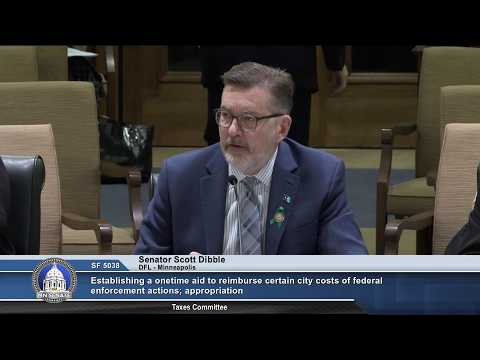
Sen. Double’s SF 50‑38 would create a one‑time $10 million program for cities to seek reimbursement for extraordinary costs tied to federal enforcement actions known as "Operation Metro Surge." Testimony from Minneapolis emergency management, a coalition of mayors, and Brooklyn Park’s police chief described millions in local costs, strained services, and poor federal‑local communication.
Sen. Double presented Senate File 50‑38, a one‑section bill with six subdivisions that would create a one‑time $10 million appropriation from the general fund to reimburse cities for documented, eligible costs tied to federal enforcement actions described in testimony as "Operation Metro Surge." The bill establishes definitions of eligible costs (police overtime, emergency management, public works, legal counsel), directs cost certification to the State Auditor by a deadline, and provides for proportional distribution of funds based on verified city costs.
Rachel Singer, identified as director of emergency management for the City of Minneapolis, said a preliminary impact assessment showed substantial impacts to city services and cited more than $6 million in police overtime, staffing and operational expenses in January alone. "We have had more than $6 million dollars are spent on police overtime," she said, summarizing the city’s preliminary estimate and urging expedited relief to avoid shifting costs onto property taxpayers.
A coalition representative (Cities for Safe and Stable Communities) described documented direct and indirect costs across member cities, including staff time diverted to surge response, legal and rental assistance, and economic disruption to local businesses. Brooklyn Park Police Chief Mark Earley testified on operational strain: since Jan. 1 his department logged over 200 overtime hours tied to the surge and estimated roughly $24,000 in direct overtime costs to date, and he described instances where federal agents operated without expected communication or standard local protocols (body cameras, identification), which he said undermined public trust and required local resources to respond.
Committee members pressed witnesses on distribution formulas and whether the proposed proportional approach would concentrate awards in larger cities with the highest documented costs. Sponsor and witnesses said the bill requires documentation and State Auditor verification and envisions proportional distribution relative to certified costs; the bill also encourages pursuing federal reimbursement where available so state funds can be repaid up to amounts received.
The committee received testimony and asked follow‑up questions; the bill was laid over for further consideration.