Get Full Government Meeting Transcripts, Videos, & Alerts Forever!
Get email alerts on the Charter Rewrite topic
No spam. Unsubscribe anytime.
Charter commission advances proposed rewrite, forwards utilities language to council after brief comment period
Summary
The Brainerd Charter Commission voted 2–1 to forward proposed charter language — including shifting utility responsibilities — to city council for review, approving a seven‑day public comment window and a reconvened commission meeting within two weeks.
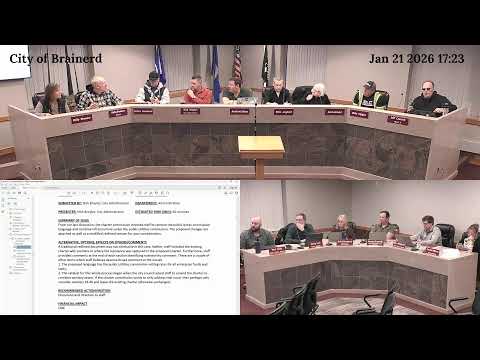
The Brainerd Charter Commission, meeting jointly with the Public Utilities Commission, voted to forward proposed charter language to the city council for consideration after a brief public comment period.
Commissioner James moved to send the proposed language to council for discussion, with a friendly amendment to open a seven‑day comment period and reconvene the charter commission in 14 days; the motion was seconded by Lambert and passed 2–1. Staff said it will email the full charter commission, city council and the Public Utilities Commission with the timeline and submission deadline.
Staff presented a packet that included a clean version of a proposed charter followed by the existing charter and a modified redline. Nick, a city staff member who led the presentation, said the draft was written so it would work whether finance remained segregated or became integrated later and that the charter, as written, would allow the city to combine sanitary functions under the Public Utilities Commission if the commission and council chose to do so. "This charter will be a good model for either one of those," Nick said.
Paul, a city staff member, explained how the proposed governance would work in practice: the Public Utilities Commission would prepare enterprise budgets and a 10‑year capital improvement plan that would be recommended to the city council, while the council would retain final approval of budgets and any special assessments. Paul said special assessments would still require the council approval process under the applicable statute and public hearings.
Commissioners debated procedure and timing. Some members argued for moving quickly — citing uncertainty about state funding and the potential for lost bond money — while others urged more time to review the full draft. One commissioner said completing the utilities-related changes quickly would allow ongoing infrastructure projects to proceed without delay.
The meeting also included detailed questions about specific provisions: staff suggested reducing the library board from nine members to five through attrition; commissioners discussed aligning terms for commissions to four years; and staff confirmed that the language referencing election judges follows state statute.
The commission approved the motion to forward the language and specified that staff will collect written edits during the seven‑day period and aggregate them before the reconvened meeting. The commission adjourned after brief member reports and thanks to staff for the draft work.