Get Full Government Meeting Transcripts, Videos, & Alerts Forever!
Get email alerts on the Lead And Copper Rulemaking topic
No spam. Unsubscribe anytime.
Stakeholders raise sampling, timeline and notification concerns at NJDEP lead-and-copper rule hearing
Summary
At a public hearing on proposed amendments to NJAC 7:10, utilities, labs and advocacy groups broadly supported stricter lead protections but faulted the proposal’s sampling protocols, compressed timelines, 1-hour notification requirement and potential costs for disadvantaged communities; written comments are due April 3, 2026.
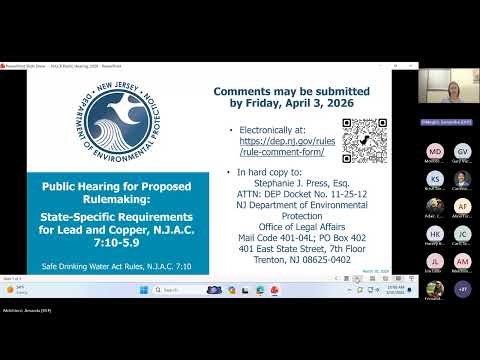
At a public hearing, the New Jersey Department of Environmental Protection sought oral comments on a proposed amendment to the state’s safe drinking water rules (NJAC 7:10) to set New Jersey-specific requirements for lead and copper in drinking water, including monitoring, corrosion-control treatment, public education and lead service line replacement.
The proposal, summarized by hearing officer Samantha “Sam” Deglio of the Bureau of Water System Engineering, was published in the New Jersey Register on Feb. 2, 2026; the department said written comments will be accepted until April 3, 2026. “We will enter them into the official record and the department’s formal responses will be issued as part of the rule adoption process,” Deglio said.
Commenters generally supported the rule’s goal of reducing lead exposure but raised technical and practical concerns. Harvey Klene, laboratory director at Garden State Laboratories, pointed to typographical errors in the draft (noting that historical lead units were misstated as milligrams per liter rather than micrograms per liter) and urged clearer instructions for the proposed two-sample approach—first-draw and a sequential fifth-liter—so homeowners performing samples would not inadvertently alter the results. “It’s critical…that the homeowner…uncap all of the bottles,” Klene said, arguing that sampling instructions should include video or other clear guidance.
Utilities and consultants warned of operational strain and cost. Cliff Keane of the Atlantic City MUA said New Jersey’s proposed tier structure appears to differ from EPA guidance and that requiring five sequential one-liter bottles and a whole-house six-hour stagnation period would impose a “huge operational burden” on systems and on homeowners unfamiliar with sampling procedures. Keane also questioned whether a single high sample could trigger extended tier-one public notification obligations.
Deandra Cameron, policy manager at New Jersey Future, said the rule’s accelerated timelines could compress planning and budgeting for many systems. Cameron urged changes to help overburdened and disadvantaged communities meet requirements, and recommended that the department limit initial mandatory replacements to confirmed lead or galvanized lines and promptly verify lines listed as “unknown.” “The accelerated timeline…could start implementation as early as July 2027,” she said in her oral comments, urging more time for planning.
Public-notification timing drew repeated criticism. Amy Goldsmith, New Jersey state director for Clean Water Action, and consultant Sandra Kutsing of CDM Smith both said a one-hour notification window for municipal officials is too short and risks error or misinformation; Goldsmith suggested using multimedia and multilingual outreach to reach vulnerable populations. “One hour certainly is pretty challenging…and we don’t want to give confusing and misinformation to people,” Goldsmith said, citing prior experience in Newark.
Technical flexibility and permitting timelines were raised by several speakers. Kutsing urged allowing temporary corrosion-control treatments within the 12-month installation window to accommodate permitting and contracting delays; she also recommended making some school and post-replacement sampling an “offer” rather than a hard “must” where sampling is infeasible. Multiple speakers warned about lab capacity and the cost and logistics of multiplying samples per site.
Operational clarifications requested included who must inventory interior plumbing and privately owned portions of service lines, how master-metered accounts should be handled, what constitutes a “reconnection” of a disconnected lead service, and whether the supplier or property owner is responsible for certain sampling obligations. John Williams, a licensed operator, asked specifically whether the water system or the homeowner is responsible for inventorying interior plumbing and how much of a building is in scope.
No formal votes or motions took place at the hearing; Deglio closed the session after asking for any final oral comments and reminding participants how to submit written testimony.
The department said its formal responses to comments will be issued during the rule-adoption process; written comments are due by April 3, 2026. Members of the public and organizations contacted the department during the hearing through the posted rule comment form and the department’s rulemaking email address.