Get Full Government Meeting Transcripts, Videos, & Alerts Forever!
Get email alerts on the Early Childhood Budget topic
No spam. Unsubscribe anytime.
Montgomery County committee adds $1 million for Working Parents Assistance, puts $125,000 advocacy post on reconciliation list
Summary
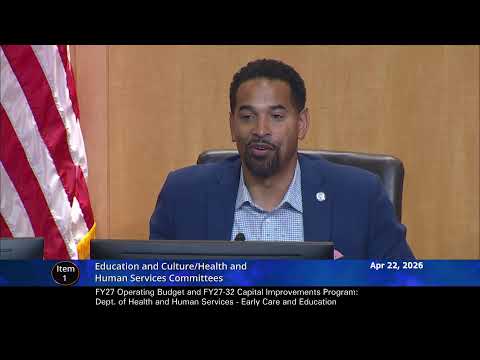
A Montgomery County joint committee agreed to add two $500,000 tranches to the Working Parents Assistance program and unanimously put $125,000 for a state‑level advocacy position on the reconciliation list, as officials described FY27 early childhood budget priorities and program realignments.
Montgomery County officials on the joint Early Care & Education and DHHS committee advanced a set of FY27 budget recommendations on early childhood services on a vote that added funding to the county�s Working Parents Assistance (WPA) program and put a state advocacy position on the reconciliation list.
The committee agreed to add the County Executive�s recommended $500,000 for WPA and, by motion and without objection, add a second $500,000 tranche to the reconciliation list to expand capacity. Committee members later moved and unanimously approved adding $125,000 to the reconciliation list for a state‑level advocacy position to support coalition building and efforts to secure dedicated funding for early childhood services.
Why it matters: County staff said the department consolidated Head Start, the county WPA subsidy and other programs into a unified Early Childhood Services unit to create a single entry point and more nimble budgeting. Officials said the realignment let DHHS clear the county WPA birth‑to‑5 waitlist and begin accepting applicants previously on the state child care scholarship waitlist. The committee heard that the local system now serves about 12,000 children but that roughly 32,000 children under 5 remain income‑eligible for subsidized care, with only about 37% of the most‑in‑need families currently served.
Details of the funding decisions: County staff told the committee that WPA currently subsidizes 766 seats and that the program had roughly $7.5 million for subsidy payments. Because the state temporarily froze new awards in the Maryland Child Care Scholarship program, Montgomery County reported a rapidly growing state waitlist for county families (staff cited a figure that has moved from roughly 690 toward 1,000 households). DHHS estimated the $500,000 County Executive tranche would allow the county to subsidize approximately 23 children moved from the state waitlist into the county WPA program (an estimate split roughly $300,000 for infants/toddlers and $200,000 for preschool‑age children). Committee members discussed that infants and toddlers are more expensive to serve than school‑age children and asked staff to keep flexibility to respond to real‑time demand.
Staff presentation and system updates: Jennifer Tonigh, Senior Administrator for Early Childhood Services at DHHS, described staffing conversions (five contracted staff recommended to become merit staff and two new positions to support expansion grantees and curriculum technical assistance). Kimberly Resnik, Executive Director of the Montgomery County Children�s Opportunity Alliance, said the system shows gains — “it increased from serving 11,000 children to 12,000” — but that a large gap between need and coverage remains. Resnik and DHHS staff highlighted shared services for providers, a child care facilities loan program that selected 19 grantees representing about 178 new seats, and plans to stand up a community‑based early Head Start for 75 infants and toddlers.
Head Start enrollment concerns: Committee members asked about a reported reduction in Head Start participation attributed to families relocating because of immigration concerns; staff said they have seen enrollment impacts and are conducting outreach and alternative placement strategies, including placing children into Pre‑K where appropriate.
Website and portal discussion: The committee also debated a proposed early care and education resource website (one‑time cost estimated at $30,000–$50,000) intended as an informational hub linking to the county�s benefits portal for eligibility and applications. Staff described the site as an accessible resource for families and community partners and said it would not duplicate portal functionality. Councilmembers raised concerns about duplication, searchability, maintenance costs and interoperability; the committee deferred final reconciliation funding decisions on the website and requested further discussion on how the site would integrate with existing county tools.
Next steps: The $1 million in WPA funding (two tranches of $500,000) and the $125,000 reconciliation request will now be considered in reconciliation and by the Full Council as part of the FY27 budget process. Staff said they will continue to monitor state actions that affect eligibility and waitlists and will use the department�s new real‑time intake and analysis to shift funds as needed.
The joint committee adjourned after finalizing its recommendations for the Full Council.