Get Full Government Meeting Transcripts, Videos, & Alerts Forever!
Get email alerts on the Asm Reporting topic
No spam. Unsubscribe anytime.
CMS explains ASM reporting, PI and Improvement Activities: penalties, scoring adjustments and data deadlines
Summary
CMS told participants that ASM uses QPP infrastructure for reporting, requires certified EHR attestation and two Improvement Activities (IA1 and IA2) for scores, and applies scoring adjustments for solo/small/complex‑patient clinicians; data for each performance year are due March 31 the following year.
CMS staff used the ASM office hour to walk through requirements for Promoting Interoperability (PI), Improvement Activities (IAs), quality reporting and how scores translate into payment adjustments.
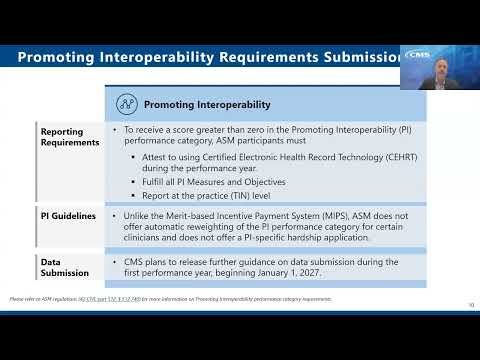
“To receive a score greater than zero for the PI performance category, an ASM participant must attest to using certified electronic health record technology… and the data submission also must be reported at the group, or TIN, level,” said Ben Puccio. He emphasized that failure to meet PI requirements will result in a negative 10‑point adjustment to a participant’s final score and that ASM does not provide automatic PI reweighting like MIPS.
CMS said two IAs are required and must be completed for at least 90 consecutive days during the performance year. IA1 concerns primary care connections and health‑related social needs screening: participants must have workflows to ensure each ASM beneficiary has a primary care provider, share relevant information back to that PCP after visits, and confirm that beneficiaries have received a health‑related social needs screening. IA2 requires at least one signed collaborative care arrangement (CCA) with a primary care practice that shares ASM beneficiaries and includes at least three of five specified collaborative efforts (data sharing, co‑management, transitions in care, closed‑loop communications, care coordination integration). “Completing only one IA results in a negative 10‑point adjustment… and completing none results in a negative 20‑point adjustment,” Puccio said.
On reporting mechanics, CMS said it will leverage existing Quality Payment Program infrastructure: data submission will use the QPP portal and will accept CMS‑qualified registries and QCDRs consistent with MIPS formats, while CMS will compute claims‑based cost measures itself from Medicare claims. “ASM data will be submitted through the QPP portal following a similar process as MIPS,” Puccio said; he added that more detailed data submission guidance will be released during ASM’s first performance year.
CMS also described scoring adjustments to mitigate small‑practice burden. “ASM participants who are solo practitioners will receive an additional 15 points on their overall final score, and ASM participants in small practices will receive an additional 10 points on their final score,” Puccio said. An additional adjustment, the complex patient scoring adjustment, can award up to 10 bonus points for clinicians treating higher‑risk or dual‑eligible patients.
On payment timing, CMS said a participant’s final score in a performance year converts into a payment adjustment applied to that NPI’s Part B covered claims in the corresponding ASM payment year (for example, 2027 performance year results affect 2029 Part B payments). CMS explained that the payment methodology benchmarks clinicians relative to peers in the same cohort rather than using a fixed MIPS threshold.
CMS urged clinicians to consult the CY2026 PFS Final Rule and ASM resources on the ASM website for detailed requirements and said the agency will post further guidance and readiness materials before the January 2027 launch.