Get Full Government Meeting Transcripts, Videos, & Alerts Forever!
Get email alerts on the Charter Governance topic
No spam. Unsubscribe anytime.
Brainerd charter commission directs staff to draft combined electric/public‑works charter
Summary
After debate over separating utilities oversight, the Brainerd charter commission voted to have staff produce a combined draft merging the electric commission and public works responsibilities and return in about 30 days; commissioners raised concerns about added bureaucracy, rate impacts and budget timing.
The Brainerd Charter Commission voted to direct staff to prepare a combined charter draft that integrates the proposed electric commission and a new public works commission and to return that draft in roughly 30 days.
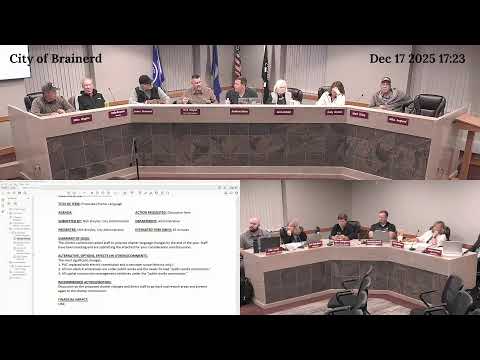
Staff member Nick presented a redline and proposed charter packet and said the most significant changes would create an electric commission focused on electricity and a separate public works commission to oversee non‑electric enterprises and capital construction management. Nick told the commission the redline was a starting point, noted version‑control issues in staff edits and said the objective was to keep the charter high‑level so future councils are not overly constrained.
Commissioners and utilities representatives spent the bulk of the meeting debating whether splitting oversight into a separate electric commission and a public works commission would simplify governance or add unnecessary bureaucracy. Mike, a member of the Brainerd Public Utilities Commission (BPU), said the proposal risks adding a third commission and more administrative burden: "I don't support three commissions. I will support two," he said, urging an approach that keeps operations simple and places more staff in the field rather than creating additional oversight layers.
Other commissioners raised related concerns. One long‑serving commissioner warned of increased costs and warned residents could face higher utility bills, noting projected near‑term increases of "3% for next year, 4% for the next year, 5% for the next year" and questioning how far cumulative rate effects could go. Commissioners also flagged clerical inconsistencies in the draft (for example, different budget presentation dates in separate sections) and urged clearer language on whether commissions would be recommending bodies or would have authority to set rates.
Staff and BPU representatives explained the rationale behind the proposals. Paul, a utilities operations official, said the baseline staff goal was to consolidate capital infrastructure oversight so large projects are better coordinated and get a deeper level of review. Staff also explained a technical budgeting nuance: governmental funds (which use levy dollars) must be set earlier in the year while enterprise fund budgets can be finalized later, which is why some sections in the draft reference different budget timelines.
The commission ultimately approved a motion to have staff combine the electric and public‑works responsibilities into a single draft for the next meeting, with a 30‑day target for staff to return with the revision. The motion was seconded and passed by voice vote. Commissioners asked staff to aim for a draft that could secure support from a supermajority of the city council when it advances for council consideration.
The commission also approved the annual, statutory letter to the district judge reporting the commission's activities and adjourned. Staff said it will accept further comments through designated staff contacts and will present the combined draft at the next scheduled meeting.