Get email alerts on the Water Resources topic
No spam. Unsubscribe anytime.
District director reports customer growth, lower per-capita use and metering progress
Summary
Water District Director Mike Loggins told the board the district grew from roughly 4,000 to 8,000 service connections since 2021, gallons-per-capita-per-day fell from about 105 to 98, lost-and-unaccounted-for water is under 10% as required by state statute, and automated metering infrastructure is being used to speed leak detection.
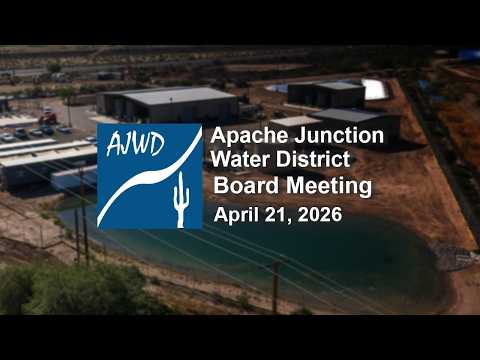
Mike Loggins, Apache Junction Water District director, told the board the district filed its annual report to the Arizona Department of Water Resources and summarized recent trends in service and demand.
"In the last three years we went from roughly 4,000 customers to 8,000 customers," Loggins said, noting that although the number of service connections roughly doubled, overall water demand rose by an estimated 25–30 percent rather than doubling. He added that gallons per capita per day dropped from about 105 in 2023 to about 98, which he credited in part to conservation efforts and rate structures.
Loggins reported the district's lost and unaccounted-for water was less than 10 percent, meeting the relevant state statutory requirement, and said the district completed an automated metering infrastructure rollout to shorten leak-notification timelines. He told the board the district's groundwater accounted for less than 1 percent of delivered water and that the system is primarily using renewable surface water from the treatment plant.
The director invited questions; none were raised immediately. The report provides the board and public with current baseline data the district will use in budget and planning discussions this spring.
AI generated
The text on this page is AI generated. Summaries, highlights, analysis, and video transcripts are all produced from the original source material.
AI can make mistakes, so if you spot one, and we will fix it for everyone.
Note: the source content is unaltered by us. Any content source we link to, be it a video, an audio recording, or a document, is presented exactly as its publisher released it. That publisher is usually a government body, sometimes an individual official or another organisation.