Get Full Government Meeting Transcripts, Videos, & Alerts Forever!
Get email alerts on the Special Education Staffing topic
No spam. Unsubscribe anytime.
PGCPS reports large drop in special-education vacancies, lays out year-round hiring and retention plans
Summary
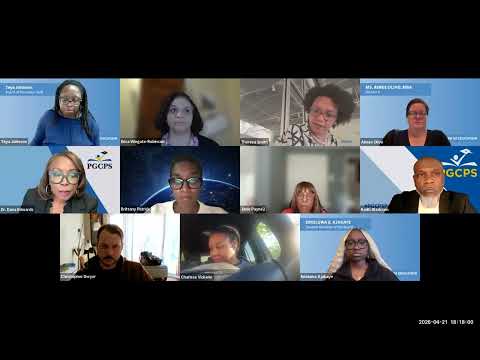
Prince George's County Public Schools told the Disability Issues Advisory Board on April 21 that targeted recruitment and process changes helped reduce special-education teacher vacancies from about 140 to 53, and that the district is pursuing year‑round hiring, dedicated recruiters and partnerships to retain and better match staff to student needs.
Prince George's County Public Schools reported substantial reductions in special-education staffing gaps and outlined steps to make gains durable at a Disability Issues Advisory Board meeting on April 21.
Dr. Dana Edwards, chief human resource officer and director of talent acquisition and management for Prince George's County Public Schools, told the advisory board the district entered corrective action with the Maryland State Department of Education over special-education vacancies and set targets to reduce openings. “We were supposed to reduce our vacancies by 10%. We far exceeded that initial KPI — we met that target by 68%,” Edwards said, adding that the figure is based on data as of March 2026. She said support-staff vacancies dropped by 47% and vacancies for speech-language pathologists fell by about 50%.
The district attributed the reductions to a number of operational changes, Edwards said: continuing to hire through the spring rather than pausing in January, offering advanced contracts and salary information to candidates earlier, designating a recruiter focused on special-education roles, and stepping up outreach and principal engagement so new hires are matched more quickly to school needs. Edwards said 36 special-education teachers had already signed advanced contracts to work for PGCPS next year.
“This year we kept hiring through May,” Edwards said. “When we bring a teacher in, we put them in the classroom — it creates an opportunity for students to have someone who has made the decision to work for us.” She also said the district increased social-media outreach, hosted targeted recruitment events (10 for special-education teachers, four for speech-language pathologists and several for related-service roles) and assigned a single staff member to manage the dedicated-aid applicant pool.
Edwards gave metrics showing fill-rate improvements: roughly 94% of school-based positions and about 93% of para-professional roles were filled on a year-over-year comparison to March, while speech-language pathologist fill rates were near 90%.
On dedicated aides — temporary positions assigned to a single student based on IEP hours — Edwards explained operational rules and limits. She said a dedicated aide can be assigned for as little as about 1 hour up to roughly a full day (6.5 hours) depending on the student's IEP, and that the position does not carry benefits. “When a dedicated aid is needed, that means there is a need for a child at that very moment,” Edwards said, describing the role as responsive and often temporary.
When board member Payne asked for current counts, Mr. Blackson (district staff in attendance to support HR answers) said the district employs approximately 455 dedicated assistants, a number he cautioned fluctuates with student needs and IEP changes. Edwards also said that, as of the previous day, the district reported dedicated-aid positions were fully filled relative to current allocated hours, while acknowledging that those numbers change as students' IEP hours are updated.
Board members pressed Edwards and district staff on retention and quality-of-hire questions. Vice Chair Patrick asked whether the district is tracking attrition and implementing retention measures. Edwards said recruitment and retention must be treated as linked priorities: “Recruitment and retention are twins,” she said, and promised more focus on retention next year, including surveying new hires and improving organizational culture.
Members also raised related-services gaps. A board member asked about occupational therapists; Edwards said the slide metrics presented focused primarily on classroom teachers and speech-language pathologists and that occupational-therapy staffing would be added to ongoing tracking. Mr. Blackson said allocations and full-time-equivalent positions are monitored for related services and that occupational-therapist allocations were close to filled, with short fluctuations possible.
Policy and partnership items drew questions as well. A board member cited a recent legislative file (transcribed in the meeting as “SB 86 86 863”) that would have converted some dedicated aides to full-time employees; Edwards and district staff said the district structures dedicated aides around student IEP needs and that the variability of those needs complicates converting the role wholesale to a permanent, full-time position without additional policy and funding decisions. Members also asked about postsecondary pipelines; Edwards described active partnerships with Bowie State University and the University of Maryland, College Park as professional-development school partners and said the district hosts job fairs and recruits year-round to convert interns and graduating students into hires.
Several members asked about the speed and accessibility of the application and accommodations processes. Edwards said the district has set an expectation to contact applicants within roughly 3–5 days (using automated acknowledgements plus human follow-up) and acknowledged staff accommodation timelines are longer than desired; she described the current process as involving the equity-assurance office and an external vendor to evaluate staff accommodation requests.
On supports for the deaf and hard-of-hearing community, district staff described a multi-year partnership with Gallaudet University that includes workshops, non-evaluative classroom reviews and annual teacher visits to model programs; staff said the work focuses on programmatic improvements and family outreach.
Edwards closed by thanking the board and stressing that many of the recruitment practices — year-round hiring, dedicated recruiters, centralized candidate pools and stronger principal engagement — are being codified so the district retains gains beyond the current corrective-action window. The advisory board will continue follow-up; the next DIAB meeting is scheduled for May 19, 2026.
Sources: Presentation and comments by Dr. Dana Edwards and district staff at the April 21, 2026 Disability Issues Advisory Board meeting.